

In the contest for the Democratic nomination for governor, “affordability” might be the most frequently used campaign watchword. Side-by-side with it is another word: Healthcare.
Healthcare “is one of the most broken systems in the whole of government,” says former Lt. Gov. Mandela Barnes. It’s “working as it was designed to,” says state Rep. Francesca Hong — in what is decidedly not a compliment to the system.
Among voters, it is “a top issue if not the top issue,” says Milwaukee County Executive David Crowley. Former Wisconsin Economic Development Corp. CEO Missy Hughes calls healthcare one of the “foundational pieces of our economy” — but one that is under strain and not working well.
For Lt. Gov. Sara Rodriguez, it’s “a complicated system” in which she made a career as an emergency room nurse, a CDC infectious disease officer and finally a health system executive — “which means that I know the levers that we can pull to try to reduce costs across the state of Wisconsin.”
Former Department of Administration Secretary Joel Brennan considers healthcare a leading Wisconsin asset, innovator and employer, but one that’s been hobbled by “the healthcare management that we are allowing to go on in this county — and it’s not helping.”
State Sen. Kelda Roys describes the healthcare system as imbued with “the worst aspects of capitalism in that we’ve injected profits before patients at every step, but none of the benefits of capitalism — there’s no free market, there’s no real competition.”
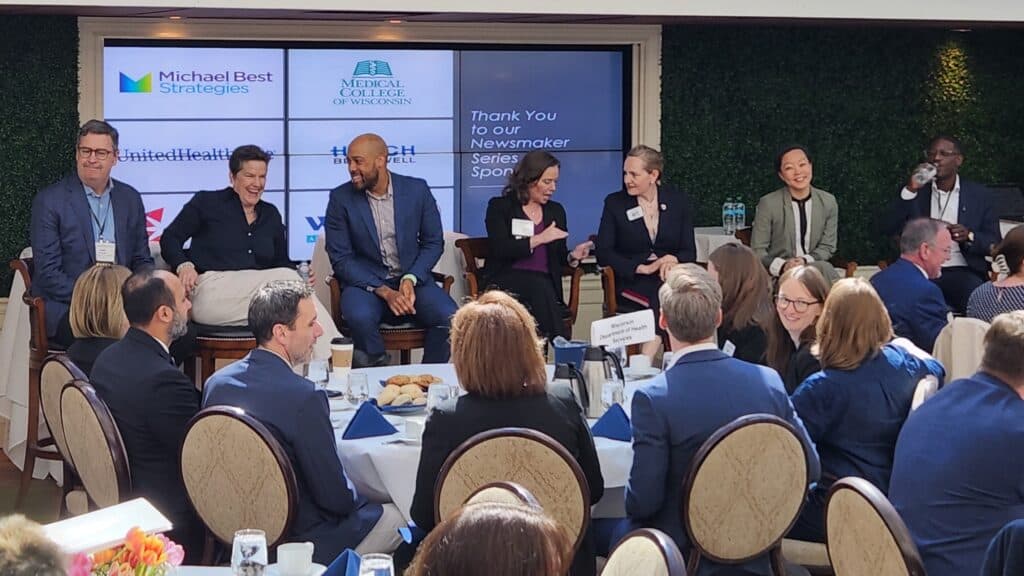
Those remarks come from three forums in April at which the seven leading Democratic hopefuls fielded questions about their healthcare policies and priorities.
Four of them — Rodriguez, Barnes, Roys and Hong — took part in a forum hosted by HealthWatch Wisconsin that focused entirely on healthcare issues. (All seven were invited, according to HealthWatch, which is affiliated with the nonprofit public interest law firm ABC for Health).
All seven joined a Wisconsin Health News event focused entirely on healthcare as well as a Wisconsin Citizen Action online forum, where healthcare led off a discussion that covered a cross-section of other issues as well.
Many of the Democratic Party rivals’ policies and priorities overlap. They all agree that healthcare costs and access are among the most important priorities for the state.
All of them say they favor a public option for health insurance — a plan that would be available for people to purchase health coverage on the Affordable Care Act health insurance marketplace if they don’t have coverage through work and their incomes are too high to qualify them for Medicaid.
All but one of the seven propose to expand Medicaid, referred to as BadgerCare in Wisconsin, under the Affordable Care Act. Expansion would open the health insurance plan for low-income Wisconsinites with incomes above the current limit (100% of the federal poverty guideline) up to 138% of the guideline.
Roys is the exception, arguing that Medicaid expansion is no longer feasible in Wisconsin because of federal changes enacted after President Donald Trump took office.
Instead, Roys proposes a public option that would allow the public to buy into the state health insurance plan for public employees. Brennan also proposes using the public employees’ plan as a public option, but he favors Medicaid expansion as well.
The other five Democrats would tie the public option to Medicaid expansion, making it possible for people whose incomes don’t qualify them for BadgerCare to pay a monthly health insurance premium for BadgerCare coverage.
Four years after the U.S. Supreme Court overturned a national right to abortion, all seven Democrats have vowed to protect reproductive healthcare and to firmly back abortion rights in Wisconsin.
All of them speak of the importance of ensuring that mental health is treated on a par with physical health. And all of them at least nod to the need to improve healthcare access in rural Wisconsin.
At the same time, each candidate’s proposals differ, sometimes in fine details, sometimes in broad priorities, and sometimes mostly rhetorically.
Federal relations
Another point of general agreement is on the need for stronger support for public health measures. All of the Democratic candidates have criticized the Trump administration and Health and Human Services Secretary Robert F. Kennedy Jr. for undermining longstanding support for vaccination against communicable diseases.
But they take different directions in their expectations for federal-state relations in healthcare. Roys, for example, writes off federal assistance during the current administration, which is why she considers expanding Medicaid a dead issue for now. Crowley’s Medicaid expansion proposal explicitly refers to federal matching funds to cover some of the costs.
None have laid out the level of detail that will be required for turning their ideas into legislation or incorporating them into the next state budget.
In the gallery below, click on the caption of each candidate’s picture to read a summary of what that candidate has said and published about their approach to healthcare policy and links to relevant pages on the candidate’s campaign website.