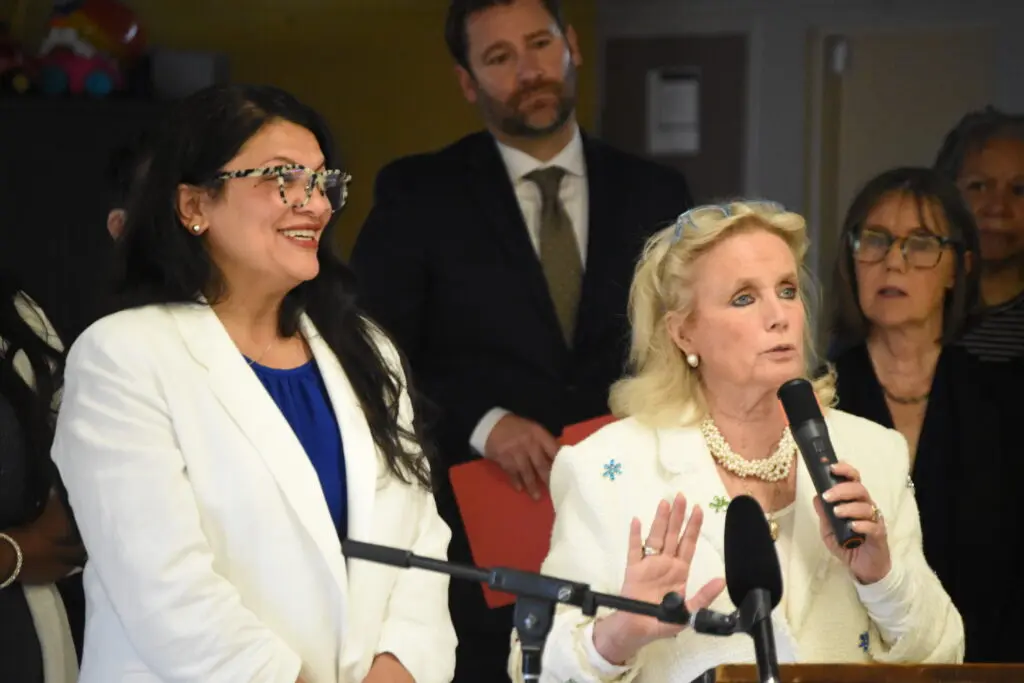


Speaking at a Dearborn Heights press conference Tuesday, U.S. Reps. Debbie Dingell (D-Ann Arbor) and Rashida Tlaib (D-Detroit) relied heavily on the framework of water as a human right in explaining the need for their two new bills that would establish a permanent federal assistance program for low-income households to pay for water.
Tlaib’s bill, the Water Access and Affordability Act, would make permanent the Low-Income Household Water Assistance Program, a COVID-era assistance program that has lapsed and not been reauthorized. Dingell’s bill, the Water Access Act, would specifically appropriate $500 million to the program for Fiscal Year 2027.
“Too many in our communities are struggling to afford the increasingly expensive water bills, from our seniors to families with children,” Tlaib said. “We hear it from all ends of our congressional districts.”
Tiana Starks, the communications director of We The People of Detroit, laid out the stakes of the program, explaining that in Detroit, more than 170,000 households experienced water shutoffs between 2014 and 2020, but that the Temporary Low Income Household Water Assistance Program helped around 30,000 families while it was still funded.
“But today, after those protections have ended, fewer than 5,000 Detroit households are able to access that level of assistance,” she said. “That means that in 2025, 10,000 households had their water shut off. That means thousands of families are once again being forced to make impossible decisions.”

Dingell emphasized the national need for this program, which would serve states and families across party lines and across the country.
“That’s why we’re going to keep working on this and reminding our colleagues in Congress, we have to get this done for every one of their constituents,” she said. “Water doesn’t care if somebody’s Republican or Democrat, they’re just kids, they’re just seniors, they’re people that need that helping hand.”
However, despite Tlaib referencing “overwhelming support around access to water,” Dingell was not optimistic about Congress’s ability to pass any legislation until after the midterm elections.
“I don’t think you’re going to see a lot pass in this Congress from now until November,” she said, adding that she hopes to see her bill included in the appropriations process for the coming fiscal year.
“We’ve already done the legwork, and I’ve already put people on notice that we’ve got to re-fund this, because the money just ran out last year,” Tlaib added on the appropriations process.

Dingell also referenced rising utility rates in Michigan and nationwide as a further reason why a federal program such as this is necessary.
“People are going without running water here in Michigan, here in the U.S., the most wealthy country in the history of the world, and people are choosing between paying their bills, their water bill, their utility bills, their energy bills, and putting food on the table and other essential things,” Bentley Johnson, the federal government affairs director for the Michigan League of Conservation Voters, said.
Throughout the event, both members of Congress and the advocates present emphasized that families should not be forced to choose between paying a water bill and other necessities.
“No person should have to decide whether they pay their water bill or buy groceries,” Dingell said. “No senior living on a fixed income should worry that turning on the faucet could mean falling behind on their medication, and no child should ever come home to a house without running water, because their family couldn’t keep up.”