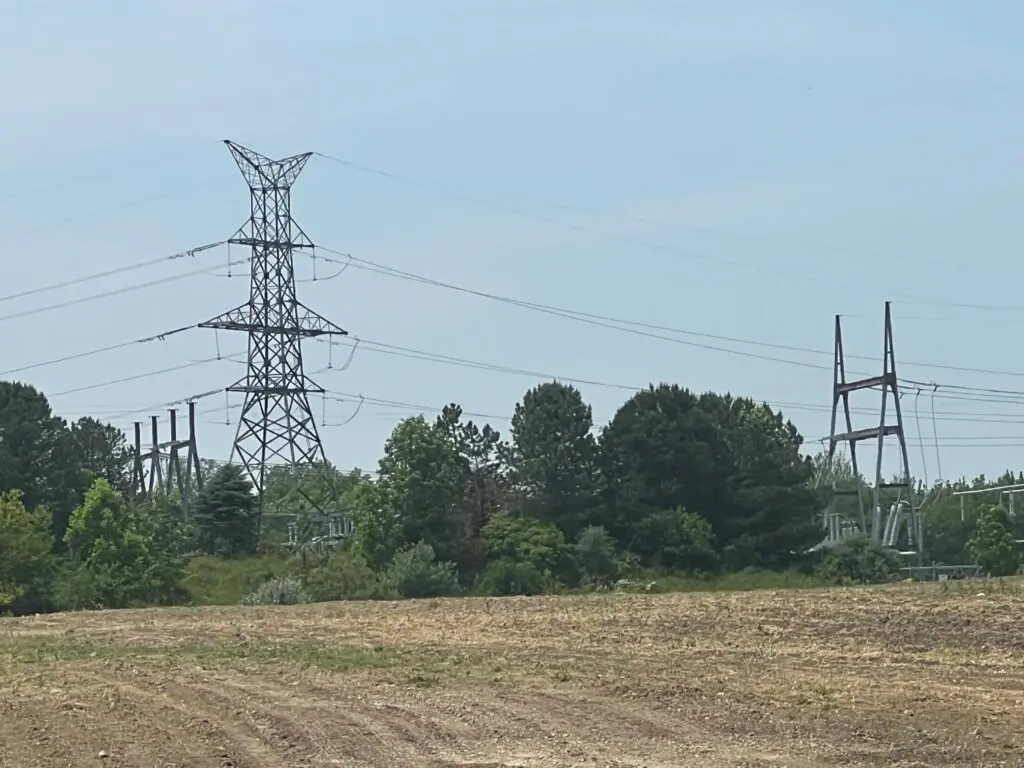


As frustration grows between some rural residents and several electrical power transmission line projects across the state, a Republican lawmaker from northern Michigan is proposing to codify the state’s utility line standards to allow for projects to be collocated in the same areas, and to allow them in limited access highway rights-of-way.
The move would help alleviate conflicts with those residents opposed to new transmission lines spanning over their private lands, moving it to an area already zoned as public property.
Under House Bill 5940, sponsored by state Rep. David Prestin (R-Red Cedar), the Michigan Department of Transportation would coordinate with a utility or transmission line developer to review requested highway corridors when companies are considering them for potential line permits. The department would share all known plans with the utility in question, including details on potential future projects, that could ultimately affect the placement of new high-voltage lines.
If a route along a highway corridor is considered permissible, identified by either the transportation department or the utility, HB 5940 establishes that the department would have to consult with the interested company. The result would be a constructability report to be used when collocation projects — projects located adjacent to one another — are planned or approved.
Prestin’s bill also states that the Michigan Department of Transportation and the company both have to approve the findings of the report before a permit can be issued for building above ground transmission lines on a given highway right-of-way.
HB 5940 would not change the statute that governs costs for utility line projects, but it would impose new requirements on the transportation department not currently outlined in statute.

Prestin said the legislation would modernize Michigan’s approach to high-voltage line siting.
“Ultimately, current law prohibits overhead electric transmission infrastructure along highways,” he said. “As a result, projects are often forced into conflict with private property owners that could have been avoided if the state allowed collocation on suitable public property.”
Prestin noted that transmission lines were the “super highways of our electric grid,” and that the state already allows for overhead lines of local transmission along roadways. He said that local lines along local roads have been a fixture in communities for decades, and that the state should adopt a similar scheme for statewide or interstate transmission lines.
“The collocation of distribution lines on existing public rights-of-way allows utilities to leverage existing public corridors, minimizing the need for additional land acquisitions or leases on private property,” Prestin said. “This means lower project costs, accelerated timelines, which translates to lower energy bills for our residents.”
Colorado, Minnesota and Wisconsin have adopted similar laws.
State Rep. Steve Frisbie (R-Battle Creek) asked Prestin whether his bill would affect the use of eminent domain if a highway right-of-way was available and permissible. Prestin said he imagined the state would see fewer instances of the practice in some of the areas where there was current friction between property owners and utility companies.
“The conflict that goes into deciding these upgrades and these new runs is significant,” Prestin said. “At the end of the day, everyone wants the path of least resistance. Eminent domain and property disputes are lengthy, costly and contentious. With this in their quiver, I really don’t see the need.”
ITC, which owns and operates the energy transmission system for most of the Lower Peninsula, ran into that friction over the last several years. A project spearheaded by the company was approved by the state’s Public Service Commission in July 2025. The company had been battling with some landowners who complained that public input concerns were ignored as the project was being routed and placed before the commission for approval.

The project included the construction of two approximately 50-mile spans of high-voltage electric transmission lines from the Indiana border starting in Branch County to a substation in Calhoun County, and another stretching from Eaton County to Gratiot County.
The tensions with landowners were so palpable that the commission, after approving the project, publicly admonished ITC and expressed disappointment over how the project was handled. The commission also vowed to make changes in the public input process to ensure that residents were heard.
ITC is currently seeking public input on its latest project, a new 50-mile line connecting its Oneida substation to a new station in Livingston County.
State Rep. Jennifer Wortz (R-Qunicy), whose 35th House District includes some of ITC’s Branch-Calhoun “Helix-Hiple” project, said the commission practically called the company a bad actor, but approved the project anyway. Wortz wondered if there was a measure of enforcement baked into the bill to hold companies and MDOT to the standards.
Prestin said while enforcement was not a main driver of the legislation, it would allow the company to get their lines from point A to point B in a more efficient manner by using corridors that already exist, instead of carving up farmland to make routes work.
“The way things are right now, with them not being able to use these corridors, it pushes them into situations where they go into direct conflict, when something like this may have allowed that to not happen,” Prestin said. “At the end of the day, if they don’t go through the most efficient route, that line loss is real.”
A representative from the Michigan Department of Transportation did not address the committee directly but indicated it had a neutral stance on the bill.
Randy Satterfield, executive director of Next Gen Highways, supported the bill and testified via Zoom. Satterfield said the organization and its partners had a hand in changing the policies in Minnesota and Colorado.
“If you can build a power line on a highway, you can speed the process, limit impacts to the environment, and maybe, even more importantly, limit impacts to private landowners,” he said.