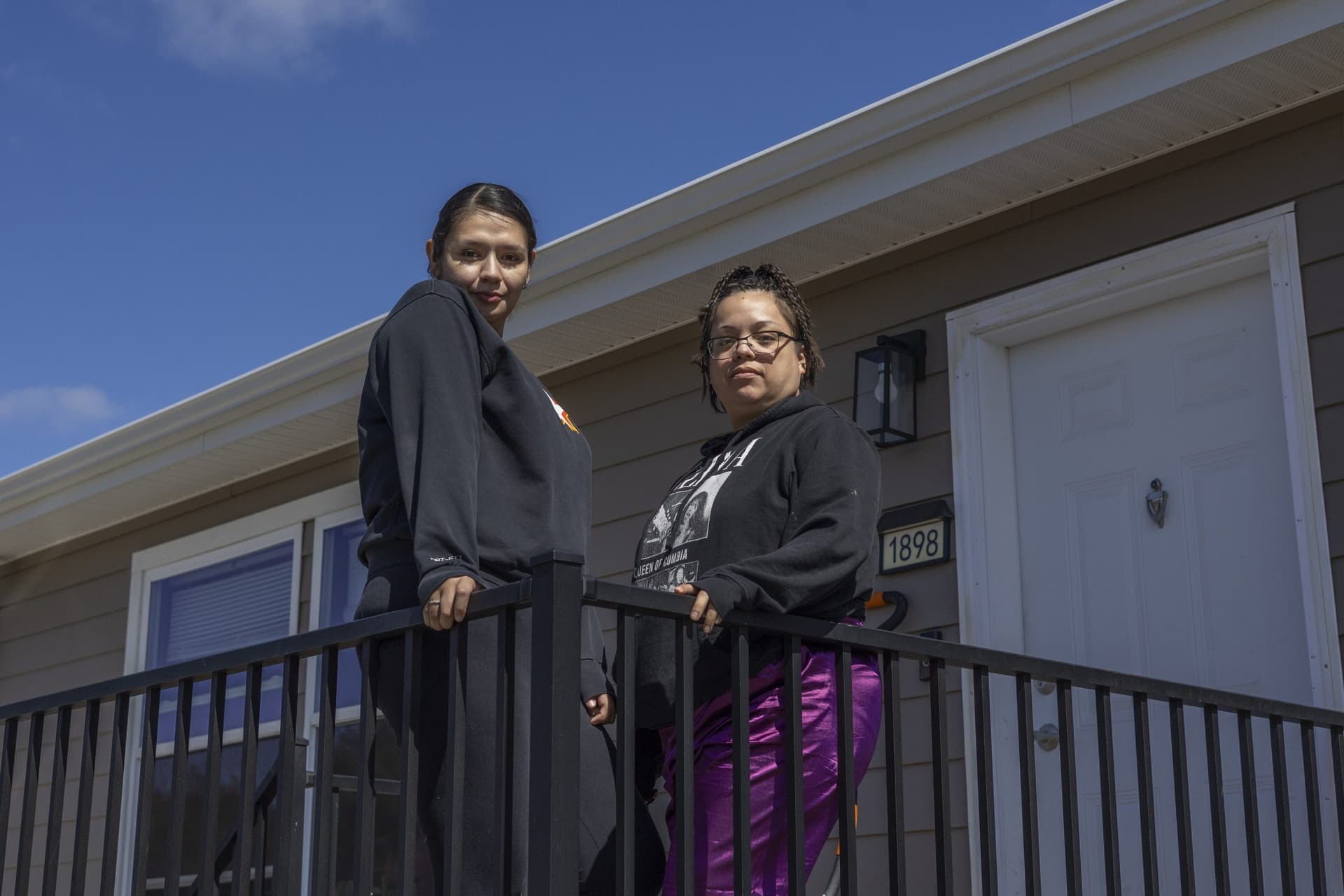


In the dining hall at Recovering Hope Treatment Center in Mora, Minn., a group of women, some pregnant, others holding babies or rocking them in strollers, clustered around tables for a weekly community meeting. Dressed comfortably, they listened as staff offered updates, helped iron out conflicts and read words of appreciation for the women’s hard work to recover from addiction.
The meeting also provided a place for the women to set recovery goals, said Jodi Kays, Recovering Hope’s residential advocate supervisor. “We ask them to talk about why they are here,” she said. “Clients say things like, ‘I’m here to improve my life,’ or, ‘I’m here to be a better daughter,’ or ‘to be sober,’ or, often, ‘to get my kids back.’”
Recovering Hope is one of only a small number of residential addiction treatment centers in Minnesota where women with substance use disorder (SUD) can live with their infants and young children, and where the children receive daily childcare. Nearly all of its clients rely on Medicaid to fund their stay. But as I’ve reported on previously for this series, impending cuts to Medicaid threaten to alter the state’s treatment landscape fundamentally.
If Medicaid funding disappears, Recovering Hope would need to pivot or shut down. Its clients and their children could lose access. But the impact would ripple, too, into the town of Mora itself, where the center has become an important, if not always popular, foundation of the local economy.

Earlier this spring, leaders were forced to reckon with that possibility sooner than expected. A letter dated May 31 arrived from Minnesota’s Department of Human Services alerting Recovering Hope that its funding would be cut off after failing to pass the department’s “revalidation” process for service providers who receive Medicaid dollars.
The cutoffs were scheduled amid intense scrutiny on the department from federal officials, stemming from fraud scandals that have plagued the state and become a focus of President Donald Trump’s second term. “We are under tremendous pressure from [Centers for Medicare and Medicaid Services] to meet the deadline in the corrective action plan and protect $2 billion in federal Medicaid funding,” a department spokesperson said via email.
Carmichael Finn, Recovering Hope’s executive director, was at home when he got news of the decision via a text from the center’s director of finance.
“I could not believe that we were staring at those words,” Finn said. “I said, ‘This must be a mistake.’” The program’s finance director called the Department of Human Services. “She was on hold for the whole day,” Finn said.
Keeping moms and kids together
Recovering Hope was founded a decade ago in Mora, a town of 3,700 people about 70 miles north of the Twin Cities. Its residential program, housed in a sprawling one-story structure planted in the middle of a field just outside of town, can host up to 86 women and 30 young children.
Nearby, two newly constructed residential buildings house up to 32 women in the intensive outpatient program. The center operates a separate outpatient program, too, for up to 96 women, offering in-person and telehealth treatment. Altogether, Recovering Hope employs about 150 people.


About 19 million children in the United States – one in four – have at least one parent with SUD, according to a 2025 study published in JAMA Pediatrics. Studies show that when mothers are able to continue caring for their children during addiction treatment, they are more engaged in their treatment and show improved outcomes like higher rates of treatment completion and lower rates of out-of-home placements for children.
Still, many mothers do not see residential addiction treatment as a viable option. Most programs do not allow children, and many mothers either do not want to be away from their children or have no alternative care option.
“People who need this essential medical service don’t usually have the ability to just leave their kids behind or drop everything,” said Wendy Jones, executive director of the Minnesota Alliance of Recovery Community Organizations (MARCO). “We’re set up with very few options to wrap around and care for individuals in these situations.”
Residential treatment programs that do allow children, known as family programs, are limited. They include several in the Twin Cities, like Wayside Family Treatment in St. Louis Park and Avivo Family Residential Treatment in Minneapolis, and some in Greater Minnesota, like Oshki Manidoo Center in Bemidji and Recovering Hope in Mora.
It’s tricky to collect comprehensive data specifically on the state’s family programs, but the Minnesota Department of Human Services funds some through its Women’s Recovery Services Grants. The department’s most recent full-year data about the grant-funded programs – some that accommodate children, some that don’t – shows that in the past year, they served about 497 women and 893 children. That’s down significantly from 2017-18, when the grants supported 1,336 women and 2,561 children.
This dearth of options for mothers with SUD isn’t unusual, said Finn, Recovering Hope’s executive director. “Some states don’t even have them at all,” he said.
Finn was raised in rural Wisconsin by parents with SUD. While his mother struggled with her addictions, staying out late and letting the refrigerator sit empty, neighbors stepped in, he said, allowing his family to stay intact. “It was chaotic but it was what I knew.”
Remaining with his family helped Finn survive, he said, and inspired his work at Recovering Hope. “Our goal here is to keep families together while Mom is healing from her illness.”
‘What’s going to happen to these families?’
Since opening in 2016, Recovering Hope has depended on clients’ Medicaid payments to operate. But on top of the recent letter warning of a stop to Medicaid dollars from Minnesota’s Department of Human Services, the federal budget bill signed into law in 2025 – called H.R. 1 or the Big Beautiful Bill – injects added unpredictability.
Under the legislation, most Medicaid recipients in the program’s “expansion population” will be required to participate in at least 80 hours per month of work, education or community service, beginning January 1, 2027. The expansion was implemented in 2014 to widen Medicaid’s reach to people who earn up to 138% of the federal poverty level.

Though on paper H.R.1 provides exemptions for people enrolled in approved addiction treatment programs or parents of children under the age of 5, recovery advocates like Finn are highly concerned.
“Historically with exemptions, especially if they are rolled out county to-county,” Finn said, “it is extremely difficult for the treatment center to coordinate that and for the client to not have a disruption in the benefits.”
Recovering Hope, like many treatment centers, operates on thin margins. Any disruption in Medicaid payments could quickly put them out of business, he said.
Brian Zerbes, executive director of Minnesota Association of Resources for Recovery and Chemical Health (MARRCH), said that the closure of family treatment programs would be catastrophic.
Parents unable to leave their young children to seek inpatient treatment will be far more likely to continue their substance use, he said. “It will play out in ERs and with law enforcement and courts and traffic accidents and deaths.”
“We are seven months away from this happening,” Zerbes said. “What’s going to happen to these families? Plans need to be made.”
Small town, big impact
Mora Mayor Jake Mathison knows plenty of people who’ve worked at Recovering Hope, including its president, Sadie Broekemeier, who served with him on Mora’s City Council. And he meets its clients around town, at the grocery store, or the nonprofit movie theater he manages.

If changes to Medicaid funding cause changes to the center, everyone in Mora would feel the impact, Mathison said. “Nothing happens in a vacuum in a rural community.”
Some Mora residents, he said, worry the center attracts people who drain the city’s resources. Mathison sees it differently, citing research showing “there is no more effect on property values when an addiction treatment center moves into your town than if a typical retail shop opens up.”
Patients’ care comes at a cost, though, said Randy Ulseth, CEO of Welia Health, the nonprofit that runs Mora’s hospital and clinic. Many clients arrive at Recovering Hope with significant health care needs stemming from years of substance use.
“From a purely financial standpoint for our organization, it costs us more money than we get paid for the care we provide for their Medicaid patients,” Ulseth said. “From a financial perspective, it would not be a bad thing for us if Recovering Hope went out of business.”
Kirsten Faurie, Mora community development director, said that any potential economic toll Recovering Hope takes is outweighed by its overall benefit to the community.
“From an economic-development standpoint, Recovering Hope creates a lot of jobs for our community,” Faurie said. “It has contributed greatly to increasing our tax base and provides a service that is needed in the community, the region and the whole state.”
Lives under construction
Recovering Hope founder Ray Ludowese is a lifelong Mora resident. More than a decade ago, after selling his construction business to his employees, he decided he was up for a new challenge.
Ludowese had been approached by the operator of a sober home about rental property he owned in town, so he began researching addiction treatment. “There are so many obstacles to treatment, especially if a woman has a child.”
After writing up a business plan, Ludowese secured funding to construct a $2 million facility. Recovering Hope opened in August 2016 with “20 employees and zero clients,” Broekemeier said. But once it opened, it grew quickly.
Though he didn’t start his career in social services, Ludowese has earned a deeper understanding of clients’ struggles. His hope, he said, is that the time they spend with their children in Mora will help set them on a new course. “That’s what we take pride in – trying to break the cycle that they’re in,” he said. “We like to help them build a new life.”
Could the end be in sight?
Soon after receiving the letter from the state’s Department of Human Resources informing them that their Medicaid funding would be cut off, Recovering Hope filed an appeal. They learned later that they were not alone in their plight. More than 3,400 providers statewide received a similar letter.
But earlier this month, they received good news – for now. The state accepted their appeal, triggering a continuation of funds during its consideration.
“The relief was profound,” Finn said, “especially when I looked around at employees and clients, knowing that I didn’t tell them that Recovering Hope is closing.”
Still, Finn is hardly breathing easily. Even if state funding is maintained, he’s concerned that before his clients can prove that they qualify for H.R.1’s exemptions, their Medicaid benefits will be cut off. Consistency is critical for people in treatment. Losing access can mean losing months of hard-fought progress overnight.

Beyond clients, Finn worries about Recovering Hope’s employees. “Honestly, sometimes I’m less worried about our clients if I have to close next year than I am about having to let all of our employees go,” Finn said. “I believe in the survival skills of our clients. I’m worried about our employees.”
When Broekemeier considers worst-case scenarios, her prognosis is dark. Without Medicaid funding, she said, “babies are going to die. Women are going to die. And we are going to un-employ about 150 people in a five-county area.”
Ludowese maintains faith that the federal government will respond to the concerns of addiction treatment providers and ensure that the exemption process works smoothly. “It’s going to be fixed somehow,” he said, “I get accused of being rainbows and unicorns, but whatever comes our way, our business model can adjust and overcome.”
Butterfly release
Clients’ children attend Recovering Hope’s licensed in-house daycare center, where caregivers are trained in trauma-informed practices and all staff attend a bimonthly meeting with a child therapist who helps them process the potential sources of the children’s behaviors.
Manager Kayla Nelson recalls one child who was about 17 months old when she and her mother moved into Recovering Hope after months living out of a car. “Mom just kept her strapped into her car seat when she was in active addiction,” Nelson said. “When she’d fall asleep or be unconscious, she felt like having the kiddo in the car seat was the safest place for her.”
The child arrived at the center nonverbal and not crawling. But during the five months she and her mother spent at Recovering Hope, she made amazing progress. By the time she left Mora, Nelson said, “She was walking, talking, running.”

Nelson said she feels nothing but compassion for the mothers, up against nearly impossible odds. “All of our moms love their kids,” she said. “When that addiction takes over, it becomes a really scary, rocky road.”
Though families only live at Recovering Hope for a short time, Nelson said that she and her staff form strong connections with the children. She has been at the center since opening day. In 10 years, she said, they’ve served 1,221 kids.
A wall in Nelson’s office is covered in butterfly cut-outs, each with the name of a child who has attended the daycare. “I see that every day – a whole wall covered with these different shades of purple butterflies.” She looks at it when the work gets challenging, she said. “I think of all the lives we’ve touched,” she said. “That is powerful. We are making a difference.”