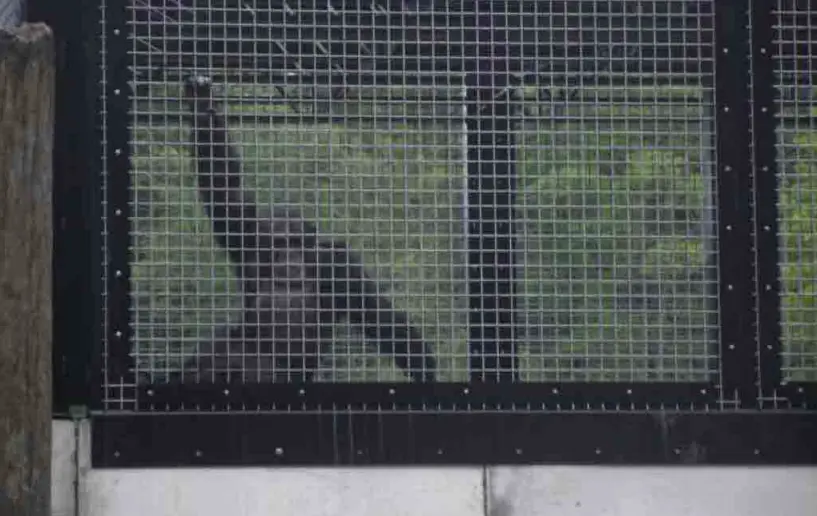


The Michigan Supreme Court has declined to hear a case brought by the Nonhuman Rights Project, a legal advocacy organization focused on animal rights, which argued that seven chimpanzees, currently all at the DeYoung Family Zoo in Wallace, Mich., should be granted habeas corpus rights over living conditions that the lawyers consider to be violations of the bodily liberty of chimpanzees housed there.
“We are not persuaded that the questions presented should be reviewed by this Court,” the order stated.
The Michigan Court of Appeals heard the case in October and denied the petition for a writ of habeas corpus to the chimpanzees, affirming a decision from the trial court that chimpanzees are not “persons” under the law. Lawyers for the Nonhuman Rights Project had been seeking a court order to show the merits of the case. That decision was officially appealed in December.
“On the face of the complaint, the chimpanzees at defendants’ zoo are not eligible for habeas relief,” the Court of Appeals decision read. “The chimpanzees are animals, and as the common law authorities all make clear, animals—including wild animals, such as these chimpanzees—are treated as property. No exception exists for ‘intelligent’ animals, which in any event has no natural stopping point.”

That question of the “stopping point” for animal rights was a key question in the Court of Appeals hearing, in which Jake Davis, the attorney for the Nonhuman Rights Project, argued that the threshold should be based on autonomy, which can be defined as “self determined behavior based on freedom of choice.”
Only one justice, Justice Elizabeth Welch, wrote a dissenting opinion in which she argued that the Court of Appeals incorrectly relied on “questionable applications of social contract theory” in defining personhood.
“This case raises profound questions about bodily autonomy and whether the law should expand to offer protection to other living beings,” Welch wrote in her dissent. “Because the common law can evolve over time and indeed has evolved with respect to habeas relief, and because our scientific understanding of the animal kingdom is constantly evolving, I believe that we should explore this issue further.”

Welch continued on to say that, despite the court’s decision, the Legislature could reconsider its animal welfare laws.
A statement from Davis following the Supreme Court’s decision called Welch’s dissent a “landmark development for the Nonhuman Rights Project and the broader movement to secure fundamental legal rights for nonhuman animals.”
“While our work is far from over, opinions like this strengthen the legal foundation upon which the Nonhuman Rights Project and future advocates will continue building toward meaningful legal recognition of nonhuman animals’ fundamental rights,” he continued.
The Menominee County Circuit Court first dismissed the case in December 2023, determining that the law’s use of the word “person” made the chimpanzees ineligible for the relief that their lawyers were seeking — transfer out of the DeYoung zoo, which they called in the hearing an “unjust confinement,” to a designated sanctuary.
The Nonhuman Rights Project filed its appeal of that decision in January 2024, arguing that Michigan common law — not a statute that includes the word “person” — should determine the outcome of the case, instead relying on the autonomy of chimpanzees.