

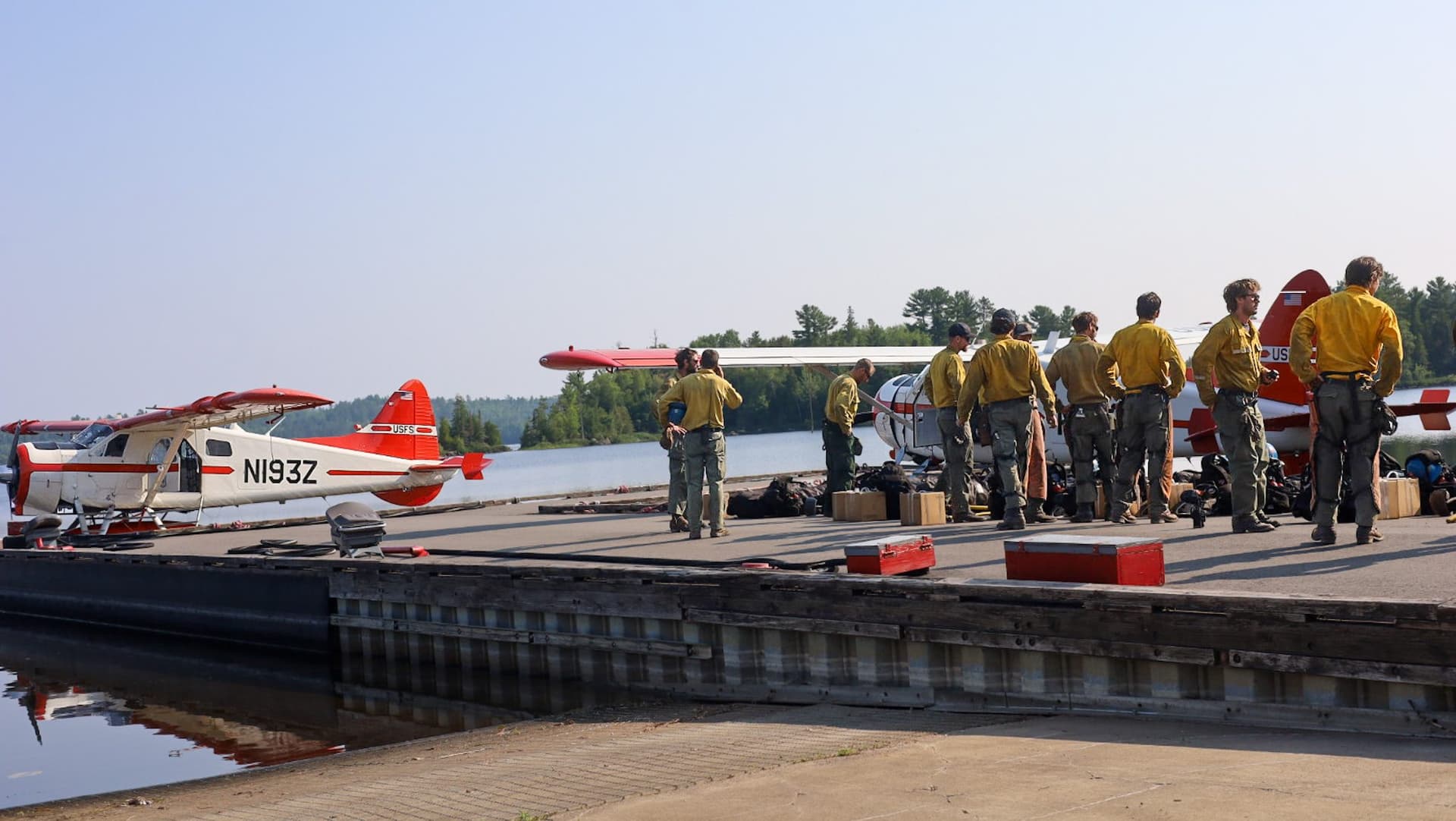
Members of the Sawtooth Interagency Hotshot Crew load gear and canoes onto float planes at the Ely Seaplane Base.
Source: Maddie Schaffer
Ely Seaplane Base carries firefighters into the Boundary Waters

Jul 30, 2026, 10:34 AM ET
Share


As crews continue battling wildfires across the Superior National Forest, the Ely Seaplane Base plays a key role in the response.
Located on Shagawa Lake, the Ely Seaplane Base is the only U.S. Forest Service seaplane base in the country.
On Wednesday morning, members of the Sawtooth Interagency Hotshot Crew loaded their gear and canoes onto two of the bases three de Havilland DHC-2 Beaver float planes to head to the Bear Trap fire.
Much of the Boundary Waters Canoe Area Wilderness can’t be reached by road. Instead, the float planes land on lakes as close to the fire as possible. Firefighters unload their gear and canoes, then paddle the rest of the way to the fire line.
“This is the easiest way to get them in there. The most efficient, most effective, and the safest way to get them in there,” said John Fish, Air Operations Branch Director with the Southern Area Incident Management Team 1.
Each Beaver is equipped with a 125-gallon tank for dropping water on wildfires. On missions like Wednesday’s, the seaplanes also get firefighters into parts of the Boundary Waters that aren’t easily accessible.
“With float planes, every lake’s an airport, and without roads and all that, the seaplanes are the best thing to use,” said Tim Olson, aviation maintenance inspector at the Ely Seaplane Base.
The float planes are one of many aircraft supporting the response.
“We also use a series of different rotor-winged aircraft, or helicopters, and fixed-wing aircraft to do different things,” Fish said. “On tactical missions, we drop water and retardant ahead of the fire. We use them for aerial intelligence as well.”
Fish said drones also use infrared cameras and mapping to find heat that isn’t always visible. That allows firefighters to target those areas.
Since the fires began, aircraft working on the fires have logged more than 627 flight hours. They’ve also delivered more than 3 million gallons of water and dropped about 120,000 gallons of fire retardant.
Fish said recent rain and the work of firefighters have allowed crews to shift to a “more direct attack rather than indirect attack.”
“I think it’s safe to say we’ve turned a corner,” Fish said. “You’re looking above 50 percent containment now across the fires, so that’s a good thing.”

Maddie Schaffer is a reporter at WBZH and WHSM, covering the Hayward area and surrounding areas in the Northwoods. Email her at maddie.schaffer@civicmedia.us.
