

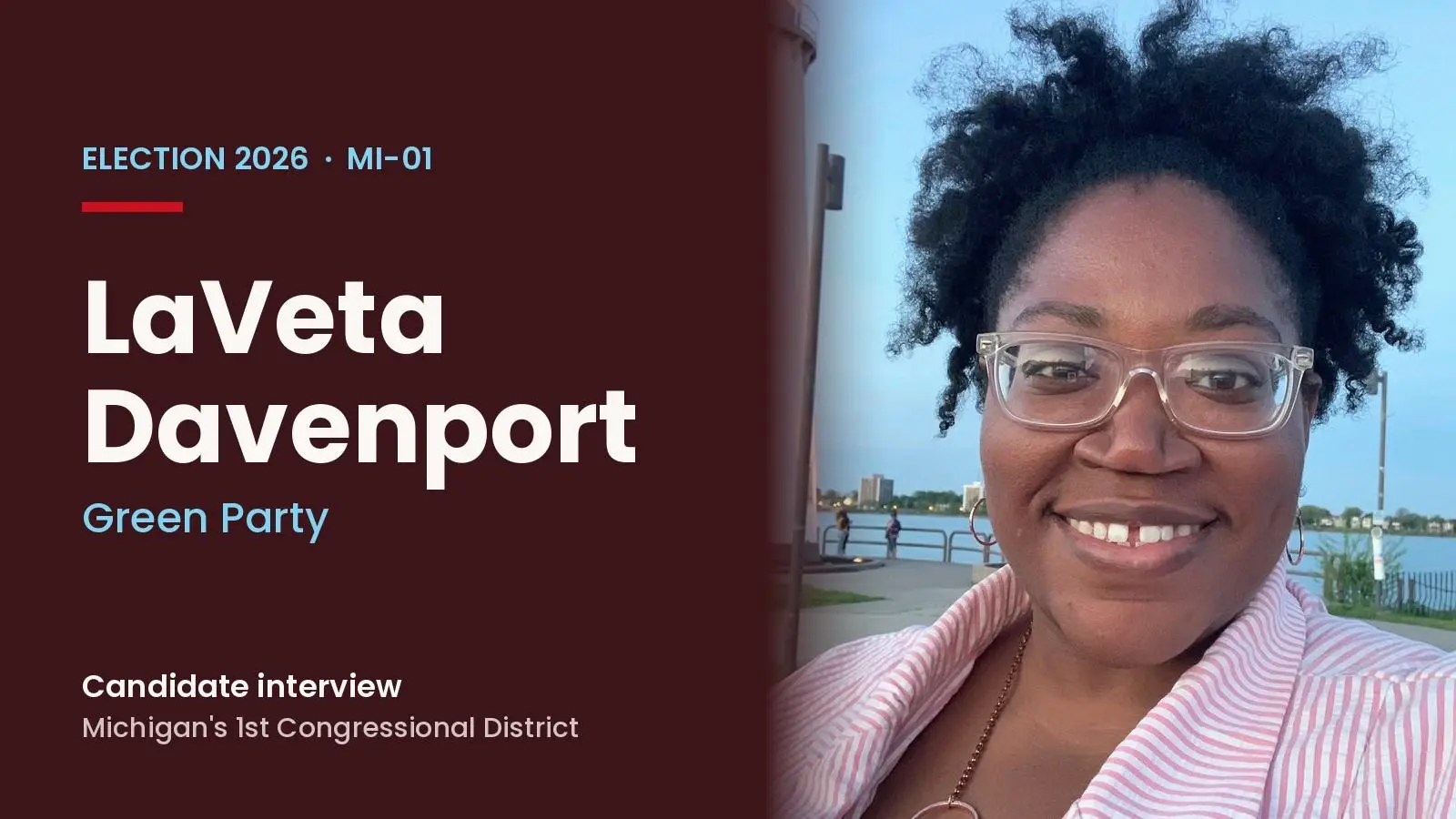
Source: Courtesy of the LaVeta Davenport campaign
Green Party’s LaVeta Davenport seeks to unseat Bergman in race for 1st Congressional District
Oct 13, 2026, 1:12 PM ET
Share


Listen:
Green Party candidate LaVeta Davenport is one of six candidates trying to unseat incumbent US Rep. Jack Bergman, R-Watersmeet in the Nov. 3 midterm elections.
Bergman also faces Democrat Callie Barr, Libertarian Arnett Satterla, independent candidate Zebulon Featherly, US Taxpayers Party candidate Doc Kovaly and Working Class Party candidate Liz Hakola in the contest to represent the northern Lower Peninsula and all of the Upper Peninsula in Congress.
Davenport spoke with WCMU about her goals for the office.
David Nicholas: LaVeta Davenport, thank you very much for joining us.
LaVeta Davenport: It's my pleasure, David. Glad to be on.
DN: My first question for you is how would you define yourself politically?
LD: Oh, that is an excellent question, David. I really don't define myself politically. I define myself more as an individual that cares about the community that she lives in, and through that care and service, the opportunity to work with the Green Party is what my affiliation has become.
But David, I don't define myself as a politician. I define myself as an individual that cares about the community around me and what that has evolved into for myself is running a nonprofit and supporting the advancement and improvement and the quality of life for those around me. Through that opportunity, I was able to connect with the Green Party and the mission and values of that party align very much with the ideals for the work that I'm doing currently and that is what led me to representing the Green Party as a candidate for the District 1 congressional seat.
DN: And what specific ideas or plans do you have to address affordability?
LD: Well, we know affordability is really — it seems like a nearly unattainable aspect of life, right? Almost the American dream started again, just being able to afford the life that we live in. And I don't think that it should be that way.
I think that the qualities of life that we experience really should be more accessible, right? And this is things like putting groceries on the table. That should be affordable. It should not be a choice between what bills you're going to pay, right? Or how much gas you're going to put in your car to get to where you need to go.
And so, these are things that definitely should be affordable and accessible, but by virtue of our current economy and decisions that have been made, we don't have that affordability.
So, the vision and goal of the Green Party includes something called the universal basic income. And that tool is a method where individuals are able to receive $1,000 per month every month simply for living in America as a citizen of America with the reality that many people … there's such a broad expanse of resources and availability out here for all of us, but not everyone can get it. Not everyone who needs to supplement their income is able to do so with government benefits and government assistance currently.
And so, the universal basic income allows for that $1,000 per month to support and kind of subsidize those needs. And it's not something that is credit contingent. It's not something that is solely based on severe need. It's something that makes life more accessible and affordable for all of us.
DN: And the next question is, what is your position on US foreign policy, specifically in Iran?
LD: That is an excellent question. When it comes to foreign policy right now, I do not agree with the way things have been handled, and that's something that I've had really some contention with on both sides of the current aisle, Republican and Democrat.
The decisions that we are making really need to be in the best interest of the American people. We have so much to tend to right here at home, and while I do truly believe that acts of tyranny should not be tolerated, genocide should not be tolerated at all, we do have to bring our resources back.
We have 50 states plus additional territories that, that need our … We have 50 states and territories that need our support, and we are focused on issues that really should be handled at an international level instead of country to country, in my opinion.
DN: What is your position on tariffs and trade wars, specifically with Canada?
LD: I have strong feelings about tariffs and trade wars as we are neighbors to the north, immediate neighbors to the north here in Michigan, and it is really impacting that affordability, right, and that access of life.
I do not agree with the way the current administration initiated the tariffs or the reasoning for placing them, and so that is something that I am thoroughly opposed to.
DN: And what is your position on construction of data centers in Michigan?
LD: Yes, data centers. I am also opposed to the placement of the data centers. A reality of life is that we are dependent on them, right? Like I believe we were probably on an app that was built by AI or with the assistance of AI, right?
So, we have a need for these centers that are able to process data and do it effectively.
However, the management and the design of the data centers is a major problem for me. We should not be using freshwater resources to cool data centers. There are many countries that have found ways to manage their data centers in more both ecological and less consuming ways. The consumption is different, which is something that is ideal.
So, with the reality that we have this technology, we benefit from this technology, I do not believe that it should go away.
But what I do believe is that where we're placing them is of concern. They should not be placed in our local neighborhoods. We should not be using our local lands to service these data centers. And also, corporations should not be able to come in and purchase these lands at deeply discounted prices to do so.
It can be harmful for our public and I am opposed to the placement of these centers, however, with the awareness that there is a need for them based on how our society is currently functioning.
We need to manage data. The design of our society has nearly mandated it, right? This is how we process. This is how we function in life, and also, I'm not saying that we need to get rid of all data centers, but we need to be responsible with the placement of these tools, and we also need to be responsible with the data that we are collecting. Invasion of privacy is a major concern, and the people are concerned. In order to have a state, we need to have land. We need to have people, and we need to have government, and our government is supposed to respect us. Our government is supposed to protect us, and so corporations that are benefiting from information and benefiting from our resources in ways that are detrimental and harmful to the public, that should be stopped and regulation should be created to assist in that process or to manage that process.
DN: And finally, how would you address the ongoing debate over the Line 5 pipeline under the Straits of Mackinac?
LD: Well, that is a tough one because, again, we're talking about our quality of … not our quality of life, but our design of life and utilizing and accessing resources for our consumption and taking ownership of those are important.
And also, our natural resources are important and putting those at risk to access those, I'm not entirely in agreement with, along with the concerns of the people that in the surrounding area that are not in support of this.
I believe our representation should be speaking for the residents that are around this bridge and that are around this pipeline.
And I do not, from what I'm hearing and what I'm seeing, feel like that has been efficient, and I do not believe that we have been protected and perceived the representation that we deserve currently.
But again, to take ownership of the resources here of that oil and to access that ourselves, instead of purchasing that from overseas, there are some benefits for it. But these conversations definitely need to be had with the constituency and the residents in the area.
This reporting is made possible by the Northern Michigan Journalism Collaborative, led by Bridge Michigan and Interlochen Public Radio, and funded by Press Forward Northern Michigan.

