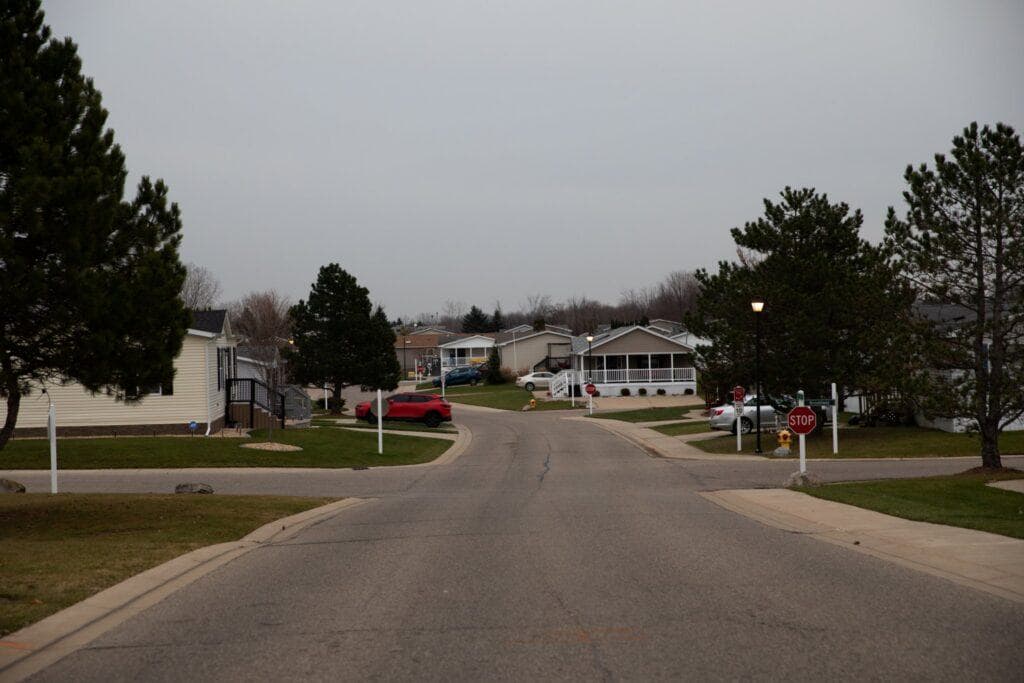
Swartz Creek Estates in Swartz Creek, Michigan, is the kind of manufactured home community that some experts say can be expanded with a new federal law that allows such homes to be built without a chassis. Some 30 states may need to update their laws, though, and mobile home park operators say the industry still faces major zoning and financial speed bumps
Source: Emily Elconin
Cheaper manufactured homes could be having a moment, if only states can catch up
For decades, manufactured home builders have been working to shed the old image of boxy trailer homes reserved for the outskirts of cities and suburbia. Now, a small change in federal regulations could open the door for architecture welcomed in more neighborhoods.
This summer’s sweeping housing bill, the 21st Century ROAD to Housing Act, removed a 1974 mandate that required every manufactured home to be built on a nonremovable steel frame, known as a chassis. Experts and home producers think the change could help unlock thousands more affordable housing options around the country.
But first, experts say, states have to examine outdated regulations that are blocking the manufactured home industry’s potential. The Pew Charitable Trusts’ housing initiative estimates that 30 states might need to change their regulations to align with the new federal law.
Unlocking manufactured homes from chassis will allow manufactured homes to become multi-family developments, said Stephanie Hawke, associate research director of land use and supply at the Terner Center for Housing Innovation at the University of California, Berkeley.
They’ll be cheaper for builders, she noted, and they’ll be easier to stack into two-story and multi-family homes.
“First of all, you were putting a very heavy, expensive thing on the bottom of these homes that is not needed and it is not used, and it’s made out of steel,” Hawke said. “If you’ve got this heavy piece of steel on the bottom of a home, stacking it becomes more difficult.”
Manufactured homes are built entirely in a factory, regulated by U.S. Housing and Urban Development codes, and then trucked to a home site.
They cost 50% less per square foot than homes built on a site, according to the Manufactured Housing Institute, an industry group. And experts say dropping the chassis could drive down costs by $5,000 to $10,000 per home.
“There’s really the opportunity to stack these manufactured homes to make multi-family developments,” Hawke said. “So it’s unlocking this thing which was primarily used for single-family and it’s making it much more accessible for a multi-family developer, which is great because manufactured housing is far and away the least expensive non-subsidized housing supply in the United States.”
This is a change that's gonna help every manufactured home community out in the country.
In a 2026 earnings call, UMH Properties, a publicly traded real estate company that owns and develops manufactured-home communities, said the chassis rule change will allow it to put two-story manufactured homes on existing lots. The company also is considering designs that could combine two stories with duplex units, allowing for smaller, more affordable apartment rentals.
“You build 2,000 square feet of homes instead of 1,000 square feet on the same piece of land. It’s a very, very important development,” said Eugene Landy, founder and chairman of UMH Properties, on the earnings call. “This is a change that’s gonna help every manufactured home community out in the country.”
Another benefit to removing the chassis, according to Mark Brunner, president of the Manufactured & Modular Home Association of Minnesota, is that manufactured homes can blend more seamlessly into subdivisions because they won’t look too different from other homes.
Under the new law, states are required to certify before July 11, 2027 — or 2028 if their legislatures meet biennially — that they will treat all manufactured homes the same regardless of whether the homes have a chassis or not. So far, at least three states — North Carolina, Tennessee and Texas — have modernized the definition of a manufactured home to align automatically with code updates from HUD.
“If you are not essentially in compliance with this new regulatory framework, then you’re really limited both in using manufactured homes and making them, which is obviously an economic driver for a state,” Hawke said. “North Carolina did an incorporation by reference, essentially saying, ‘We are just going to define this like HUD defines it. Go see HUD’s definition.’ It’s a lot simpler.”
From temporary housing to mobile home parks
Rachel Siegel, a researcher and policy expert for Pew’s housing initiative, said her research has found that more than 30 states are going to need to update their definition of manufactured housing to remove language about a required chassis.
HUD certification now requires equal treatment of homes with and without chassis, and changes to state laws may not be as easy as striking a few words, she said. References to permanent chassis can appear throughout state statutes in various manufactured home policies.
“States vary completely across the country on how they treat manufactured housing,” Siegel said. “This requirement of permanent chassis is really pervasive.”
A Stateline review found use of the “permanent chassis” language currently written on manufactured housing laws include Virginia, Maine, New York, Missouri, South Carolina, Washington, Nevada and Maryland.
Following World War II, a shift in how mobile homes were being used began forming. No longer reserved as temporary housing, mobile homes were designed to be increasingly more permanent. Mobile home communities sprang up, though many were zoned into rural or suburban areas on a city’s edge.
For decades, manufactured homes — called mobile homes until the early 1970s — have been built in factories and trucked to their new locale. Many were unloaded into mobile home communities, specialized zoning districts where residents own their house but rent the land underneath.
They are far cheaper than site-built houses: The average sales price of a new manufactured home rose from $81,900 in 2019 to $127,200 in 2025, according to the U.S. Census Bureau’s Manufactured Housing Survey.
Those factory-built sales have slowed since a late 1990s boom as fewer manufactured home communities have been built since 2000, a trend largely attributed to restrictive zoning and rising land costs. Still, an estimated 20 million people live in one, most of them on acreage owned by a landlord.
In the past, a home attached to a trailer or visibly hoisted a few feet off the ground were tells of manufactured housing when they first popped up in neighborhoods. But many modern ones are virtually unrecognizable from site-built homes.
“They have the same walls, ceiling, sheetrock, windows and shingles,” said Dustin Brakemeier, who owns and operates manufactured home communities in Minnesota and Wisconsin. “One’s built in a factory, one’s built outside. They’re the same.’”
Changing zoning, mortgage rules
Pennsylvania Republican state Rep. Dan Moul, who owns a manufactured home park in Oxford Township in Adams County, recalled in an interview that zoning restrictions kept him from expanding the community into an adjoining parcel a few years ago. The township said the land was zoned exclusively for detached single-family residential housing.
“The bottom line is they look at mobile home communities as that’s where the poor riffraff lives, and we don’t want any more riffraff,” Moul said.
One of the big domino effects from the removal of the chassis requirement could be state banning or overriding restrictive local zoning policies that targeted manufactured homes.
In an analysis of over 6,700 zoning districts in Texas, the National Zoning Atlas found 33% of localities have explicit restrictions on manufactured housing and 11% allowed them via special hearing or permit, but not by-right.
Last year, Kentucky and Texas banned local ordinances that would unreasonably restrict where manufactured homes could be placed. Kentucky also insisted that local governments cannot impose design standards for manufactured homes that are higher than those for non-manufactured homes.
Alex Rodino, a real estate agent in Savannah, Georgia, who sells manufactured homes, said the stigma isn’t just among local governments and stodgy neighborhood groups. Some buyers, he said, are confusing modern manufactured housing with the image of older mobile homes.
“I think (that perception) is slowly changing as construction quality improves and traditional housing becomes less affordable,” said Rodino.
Siegel, of Pew, said that because states must align their manufactured housing laws with HUD’s definition by 2027 – there’s an opportunity for states to take a holistic look at their regulations, including whether states can make it easier to define manufactured homes as “real estate.”
Siegel said states also should revisit laws that classify manufactured homes as personal property — like cars.
“If you own property that’s personal property instead of real estate, you’re not eligible to get a mortgage,” Siegel said. “That’s not about a person’s financial status or financial credibility, and it’s not even about the quality of the home. It’s just this titling component.”
A Pew analysis touting the potential for manufactured homes shows that a typical $100,000 mortgage for a manufactured home would save a borrower roughly $49,000 over the life of the loan when compared with “home-only” or personal property loans, which are the only options now.
Some states already are taking action: Laws in Georgia, Maine and New York have made it easier for some manufactured homeowners to convert their homes to real property and gain access to mortgage financing.
“If we’re going to title manufactured homes without a chassis the same way as we’re titling manufactured homes with a chassis, let’s make sure that that process is as streamlined and makes the most sense for what these modern homes are today,” Siegel said.
Stateline reporter Robbie Sequeira can be reached at rsequeira@stateline.org.
Originally published by Stateline, a nonprofit news organization.