

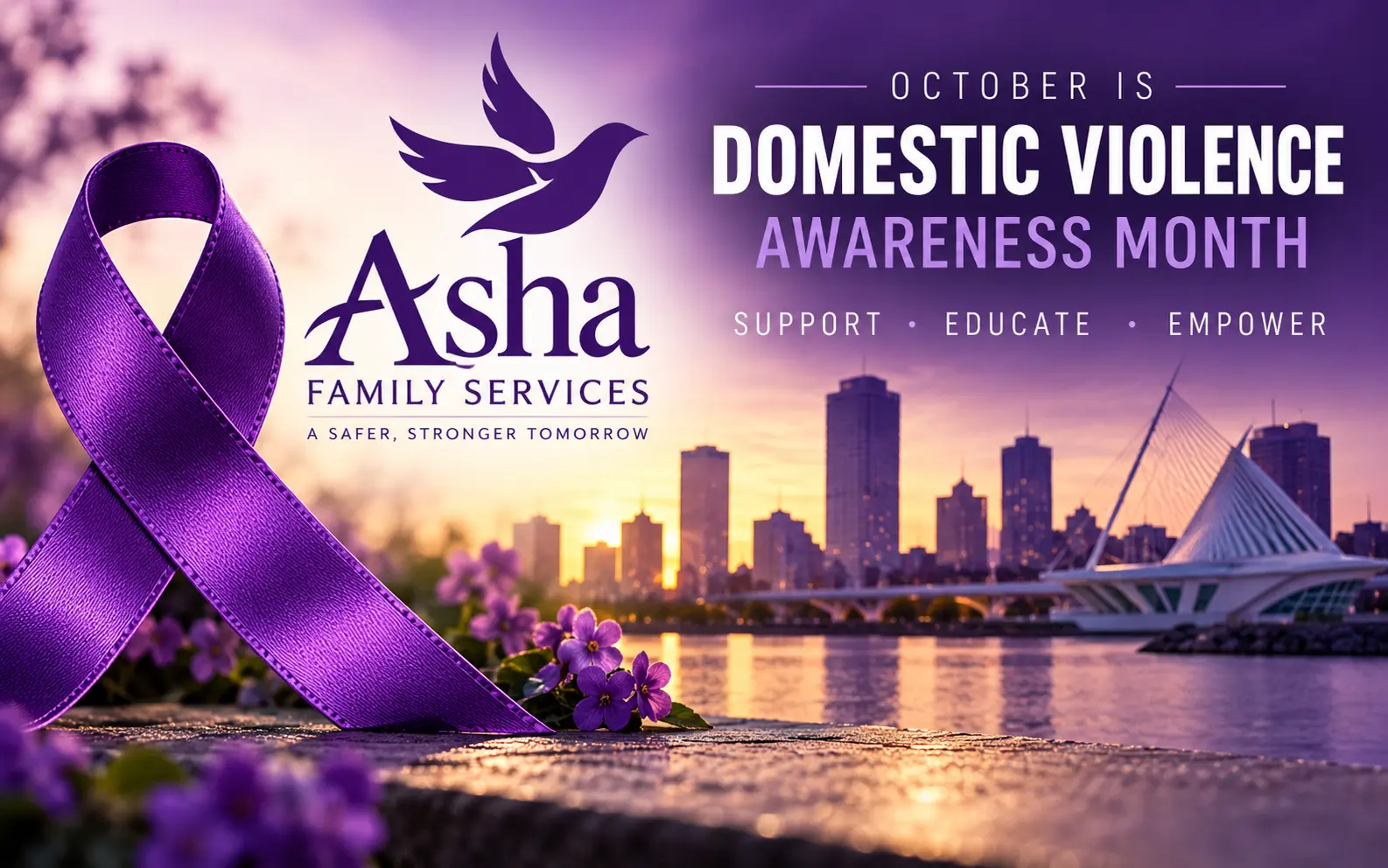
Asha Family Services Partners With Civic Media to Expand Domestic Violence Awareness

October is Domestic Violence Awareness Month, bringing attention to the need for resources and support for survivors. Asha Family Services (Asha) has partnered with Civic Media to increase visibility and expand its reach in Milwaukee.
Asha Family Services Founder/CEO, Antonia Norton, discusses the partnership and its anticipated impact.
“For nearly four decades, Asha Family Services has worked to address domestic and intimate partner violence in Milwaukee, particularly within African American communities. One of the lessons we have learned is that providing services is not enough if the people who need those services do not understand what is available, or are afraid to reach out,” Norton said. “Given this lesson, our interest in working with Civic Media is grounded in the importance of reaching people where they are, providing information that is accessible, and opening conversations about domestic violence that too often remain behind closed doors.”

Civic Media serves the Milwaukee market through local radio stations, 860 WNOV and 101.7 The Truth, and also through its community media presence through the Milwaukee Courier Newspaper.
That commitment to serving the community aligns with the mission of Asha, founded in 1988 to address the needs of African American women experiencing domestic violence who were often underserved by traditional systems.
Asha provides crisis intervention, safety planning, counseling, case management, housing assistance, and community resource referrals to survivors of domestic violence.
Two of Asha’s longstanding programs include the Sister Circle Support Groups, established in 1988, and the Ujima Men’s Program, formally established in 1994, which focuses on keeping women safe by working with men who have used violence in their relationships. The program helps participants examine their behavior, understand the harm they have caused, take responsibility for their actions, and develop healthier ways to manage conflict and relationships. Recognizing that some individuals who use violence have also experienced abuse, Asha emphasizes the importance of addressing both the needs of survivors and the behaviors of those causing harm.
An extension of this work is a new innovative component, The Dock. A short-term residential program that gives men an opportunity to step away from potentially volatile situations, receive support, and address behaviors that put themselves and others at risk. Not serving as a shelter, The Dock provides an opportunity for early intervention to help prevent serious injury or death.
Norton believes one of the most urgent issues facing Milwaukee families and deserving more public attention is the connection between domestic, intimate partner violence and violence occurring in our neighborhoods.
“Social media plays a significant role in fueling these associations. For too long, these issues have been addressed as though they exist in separate worlds. Yet the same individuals, families, and neighborhoods can and are impacted by both,” said Norton. “We must also pay greater attention to the disproportionate impact of domestic violence on African American women, particularly the risk of severe injury and homicide.”
Recently, Asha brought together women who survived near-fatal domestic violence to share their experiences and convened community leaders and service providers to discuss needed changes. One of the most troubling findings was that many survivors felt their lives and experiences did not matter.
“We also need greater public awareness of the warning signs that domestic violence may become deadly. These include strangulation, threats, stalking, threats to kill, controlling someone’s movements or activities, and behaviors intended to frighten, intimidate, or control a partner,” said Norton. “I have often said, if we continue responding only after violence has occurred, we will continue mourning lives that might have been saved.”
Asha was founded to address the needs of African American women and families; their services are available to people of all racial and cultural backgrounds.
“Our responsibility is not simply to continue doing what we have always done because it is familiar; sometimes the answer is having the courage to do something different. That is the thinking behind SOS and The Dock,” Norton said. “Ultimately, I want people to understand that Asha is here to help, that survivors deserve safety, dignity, and support, and that preventing violence requires all of us.”

Karen Stokes is a Milwaukee-based freelance journalist with more than 16 years of experience reporting on local and national politics, as well as community interest stories that highlight culture, social issues, and civic engagement for local, regional, and national publications.
