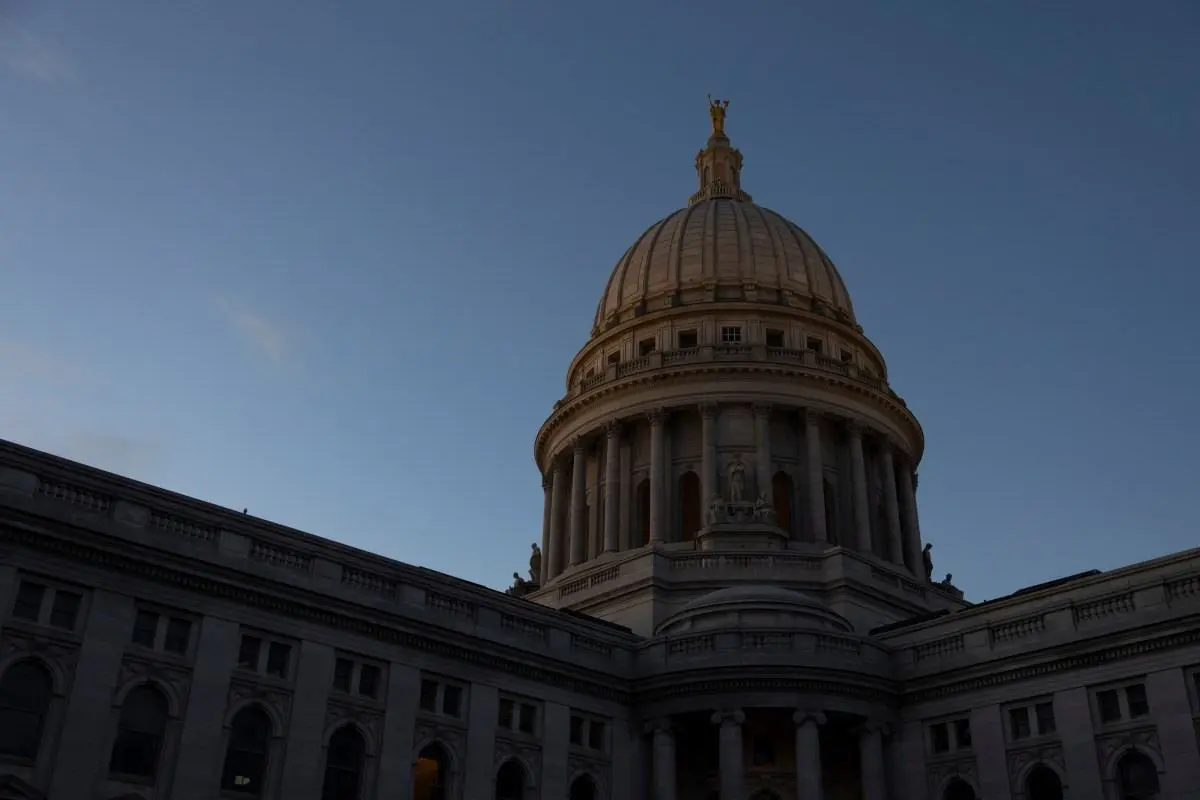
The Wisconsin State Capitol is photographed on Nov. 11, 2024, in Madison, Wis
Source: Joe Timmerman / Wisconsin Watch
Here are 7 things to watch for as Democrats take control of Wisconsin state government
Gov.-elect David Crowley must assemble a transition team, legislative leaders will be elected, and Tony Evers may issue first commutations in decades.
The campaign is over. Democrats are headed for complete control of the Capitol for the first time since 2010. But the last two months of Gov. Tony Evers’ administration remain.
Over the coming days there will also be significant attention to how Gov.-elect David Crowley prepares for his new role and how Senate and Assembly Democrats get ready to govern after years in the minority.
Here are seven things to watch for in the weeks and months ahead.
Who joins the Crowley transition
Crowley has less than two months until he is sworn in as governor. During that time, a transition team will help him prepare for the role.
The governor-elect will receive state dollars to help fund transition efforts. As required by state statute, the Republican-led Joint Finance Committee is scheduled to meet at noon Tuesday to approve funds for Crowley’s transition budget. In 2018, the committee approved nearly $95,000 for then-Gov.-elect Evers’ transition.
Evers in 2018 also announced members of his transition team and key roles in his administration, such as chief of staff.
As of Friday, Crowley had not made any of those announcements, and his campaign did not respond to questions from Wisconsin Watch about when they might be shared. He did tell reporters he wants his transition team and future Cabinet to represent “the entire state of Wisconsin.
“I’m not looking to just bring Milwaukee and Madison to Madison,” he said.
Assembly and Senate leadership votes
The post-election time period is also when the Republican and Democratic legislative caucuses meet to determine their top leaders for the upcoming session.
Senate Democrats and Assembly Democrats are scheduled to meet Tuesday when lawmakers are expected to choose their leaders as they prepare to take the majority in both chambers for the first time in more than a decade. Senate Minority Leader Dianne Hesselbein and Assembly Minority Leader Greta Neubauer, who led the campaign committees for their respective chambers, sent letters to their caucuses after Election Day about their intent to seek the top positions in their chambers and the high stakes ahead.
“The coming months will be exciting and challenging. The responsibility of governing is great,” Hesselbein wrote.
The Middleton lawmaker has led Senate Democrats since December 2023. “The expectation from our constituents and the citizens of Wisconsin to achieve legislative successes on their behalf to improve their lives and make the future even more bright for the next generation is self-evident. Wisconsin families are counting on us and we must now deliver.”
Neubauer has led Assembly Democrats since January 2022. If Neubauer is selected, she would be the first new Assembly speaker in more than a decade and the first woman in state history to serve in the role. Retiring Republican Speaker Robin Vos took the job in 2013 and became the state’s longest-serving speaker.
“We need to pass a visionary policy agenda that will lower costs, support our public schools, protect our rights and freedoms, help working families, ensure safe and welcoming communities, hold big corporations accountable, fight back against federal overreach, ensure a clean environment for future generations, and much more,” Neubauer wrote to Assembly Democrats. “People must see and feel the results of our work. We must set Wisconsin on a new path.”
Senate Republicans already met, electing Sen. Julian Bradley, R-New Berlin, last week to serve as Senate minority leader. Bradley, the first Black lawmaker to serve as a caucus leader, takes over Republican Senate leadership after Sen. Devin LeMahieu, R-Oostburg, chose not to run for reelection this year. Bradley was first elected to the Senate in 2020.
“Tuesday’s results changed the math in the Senate, but they didn’t change what we believe or who we work for,” Bradley said in a statement. Senate Republicans in the new session will be focused on “protecting taxpayers and expanding opportunity for every Wisconsinite,” according to the statement.
News outlet WisPolitics.com reported that Assembly Republicans are also scheduled to meet this week and that Walworth Rep. Tyler August, who has been the Assembly majority leader, plans to run for minority leader.
Evers’ final pardons and commutations
Evers signed off on his last bills and vetoes when the Legislature adjourned earlier this year, but key remaining issues before the governor prior to leaving office are his decisions on pardons and commutations.
It’s not clear when exactly those decisions will be announced. The deadline for individuals seeking a pardon from Evers during his final months in office was Oct. 5. Evers has issued a record-breaking 2,443 pardons as of late October, according to his office.
The Commutation Advisory Board, which is scheduled to meet again on Nov. 20, held its first hearing in August. In a July letter sent to a victim of a commutation applicant, the board wrote that commutation decisions would typically be made “two to three months after a hearing.”
Evers reinstated a commutations process in the state via executive orders earlier this year. The last governor to issue a commutation was former Republican Gov. Tommy Thompson.
Last week, outgoing California Democratic Gov. Gavin Newsom commuted the death sentences of all prisoners facing execution in the state, a total of 548 people, according to an open letter from his office. Pardons and commutations can result in political blowback, especially if someone granted clemency reoffends, so it’s not surprising to see governors use that power in their final days in office.
Waukesha County executive special election in December
A large number of Republican lawmakers are ending their time at the Capitol in the coming weeks, whether through retirements or election defeats. At least one more is expected to join that group in December.
A special election is scheduled Dec. 15 in Waukesha County to choose the next county executive. The role became vacant after the death of Paul Farrow, who was first elected in 2015. Farrow was also a former chair of the Republican Party of Wisconsin.
State Rep. Adam Neylon, R-Pewaukee, and Sen. Chris Kapenga, R-Delafield, are the only two candidates for the post. Both lawmakers were reelected to their legislative districts last week, with Neylon winning by 10 percentage points and Kapenga winning by more than 30 percentage points. They both have spent more than a decade in the Legislature.
If either lawmaker is elected, state law says lawmakers must resign from their current office within 60 days of the certification of the county executive results. The governor is able to call a special election for a legislative seat after a member resigns.
Inauguration, swearing-in ceremonies scheduled in January
Crowley, Attorney General Josh Kaul, Secretary of State-elect JoCasta Zamarripa and Treasurer-elect Yee Leng Xiong will take their oaths of office on Jan. 4, 2027. The governor typically gives an inaugural address that same day.
That day will also mark the start of the new legislative session. State lawmakers will be sworn in in both the Assembly and the Senate, kicking off Democratic control of the Legislature.
The governor’s budget presentation
Wisconsinites will not have to wait long after Crowley’s inauguration to hear his financial plan for the state. Crowley is required to present his first biennial budget to the Legislature by the last Tuesday in January of odd-numbered years, but can ask for an extension from the Legislature, according to the Legislative Fiscal Bureau. Crowley told reporters after Election Day that his key priorities will be lowering costs, such as health and child care.
After Crowley presents his budget, the Joint Committee on Finance, led by Democrats next year, will hold public hearings to determine the Legislature’s priorities. State agencies have already submitted their requests for the next budget to the Department of Administration
Another Wisconsin Supreme Court election in April
In less than five months from now, Wisconsinites will cast their ballots in another statewide election in April with a possible primary in February if there are more than two candidates who file to run.
There is an open 10-year Wisconsin Supreme Court seat on the line after conservative Justice Annette Ziegler announced earlier this year she will not seek a third term.
Clark County Circuit Court Judge Lyndsey Brunette and Milwaukee-area Court of Appeals Judge Pedro Colón have announced plans to run. Brunette previously served as the Democratic Clark County district attorney. Colón spent a decade as a Democratic lawmaker in the Assembly.
It remains to be seen if conservatives will field a candidate after losing five of six contests since Ziegler ran unopposed in 2017. Liberals hold a 5-2 majority in the current term.

Originally published by Wisconsin Watch.