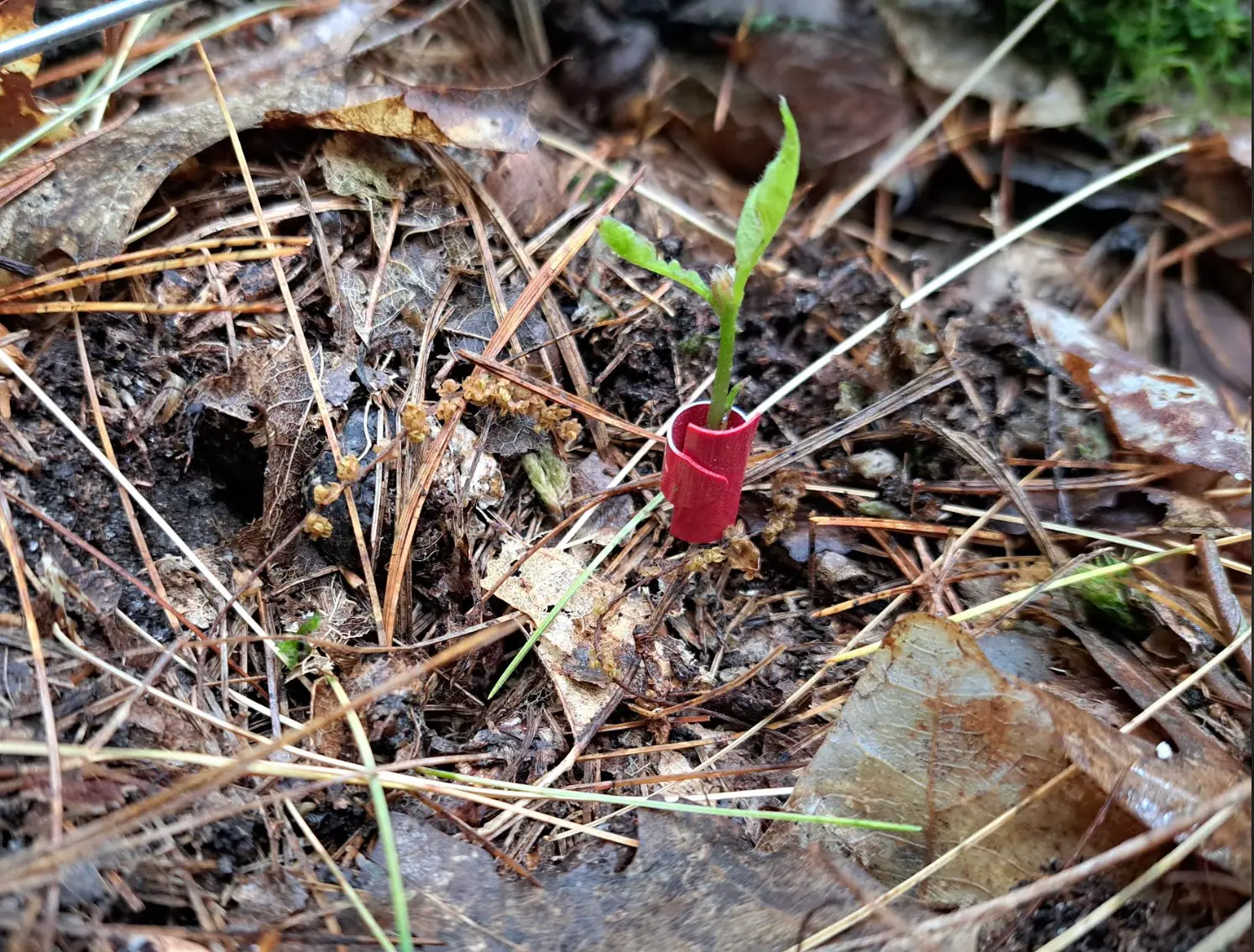


- Researchers are using nearly three decades of seedling data from Michigan’s Manistee National Forest to understand how the state’s forests may change in the future
- Climate change could favor some tree species, including red and white oak, red maple and black cherry, while making it harder for species such as sugar maple and American beech to regenerate
- Deer browsing, invasive pests and diseases could also shape Michigan’s future forests, making long-term monitoring of seedling survival critical to understanding which trees will reach maturity
The future of Michigan’s forests may be taking root beneath the trees we see today.
Every summer for the past three decades, researchers have returned to the same 12 patches of land in Michigan’s Manistee National Forest to look for some of the smallest signs of change: seedlings. They track which seedlings appear, which survive and how environmental conditions may influence the next generation of trees.
The research suggests a changing climate could benefit some species while making conditions more difficult for others, but climate is only one factor shaping Michigan’s forests. Deer browsing, invasive pests, disease and changes in forest structure could also determine which seedlings survive long enough to become mature trees.
Richard Kobe, a forest ecologist at Michigan State University, started the long-term research project in the late 1990s. Bailey McNichol, a postdoctoral scholar who worked with Kobe on the project, helped lead recent research examining how climate conditions influence the emergence of young trees.
Bridge Michigan interviewed Kobe, a forest ecologist and core faculty member in MSU’s Ecology, Evolution and Behavior program, and McNichol about the seedling census and what their research reveals about the future of Michigan’s forests. Their responses have been edited for clarity and brevity.
Why focus on seedlings?
Kobe: The seedlings that are appearing now are the future big trees.
Some tree species are able to take advantage of disturbances. If a windstorm blows down trees or there’s a harvest, you can get an open area in the forest. Certain species can disperse seeds into that opening and grow quickly.
But there are many species that depend on having seedlings already established in the understory. When a large tree eventually dies, those seedlings can take advantage of the space that becomes available.
Because it can take decades for a seedling to reach the canopy, studying seedlings offers a glimpse of what Michigan’s forests may look like in the future.
What have you learned from returning to the same forests for so many years?
McNichol: One thing I’ve really come to appreciate is just how sensitive seedlings are.
Most seeds that fall to the forest floor never become seedlings. They might be eaten by insects or mammals, develop a fungus or simply encounter weather and climate conditions that aren’t right for them.
Depending on the species, often 90% or more of the seedlings that initially emerge don’t make it to their one-year birthday.
Kobe: I think one surprise for me was how stable these forests seemed to be, even though there was so much turnover happening underneath.
Seedlings are constantly coming in, and they’re constantly dying. You have this ongoing process of regeneration.
Another surprise was how variable tree reproduction is from year to year. Some years, trees produce a lot of seed, and other years they produce very little.
It also seems that just a few large trees in a local area can be responsible for producing a lot of the seeds and seedlings in that area.
How is climate change affecting Michigan’s forests?
Kobe: We’ve definitely seen changes in weather patterns, with rising temperatures, longer dry periods and more intense rainfall. Different tree species respond differently to those changes, so understanding which seedlings survive is just as important as knowing which ones emerge.
McNichol: Using more than two decades of data, we found that warmer conditions are likely to favor species such as red maple, black cherry, red oak and white oak, while limiting recruitment of sugar maple, American beech, basswood, white ash and black oak. That could have important ecological and economic consequences, particularly for sugar maple, which supports Michigan’s maple syrup industry.
Does that mean oaks will thrive in Michigan’s future forests?
McNichol: It’s more complicated than that. While warmer conditions may favor northern red oak and white oak, deer browsing and increasingly shady forests can prevent those seedlings from reaching maturity. Some oak seedlings in our study have remained knee-high for 15 or 20 years because they’re repeatedly browsed by deer, while denser forests favor shade-tolerant species like maples over oaks.
How are deer changing the way Michigan forests regenerate?
McNichol: In places where deer are abundant, they can have a huge impact on forest regeneration. In some areas, 80% to 90% of oak seedlings are browsed, compared with 10% to 20% in others. Repeated browsing can keep seedlings from growing normally, while allowing ferns — which deer don’t eat — to spread across the forest floor. Those dense fern layers make it harder for tree seedlings and other understory plants to establish, meaning deer can reshape the entire forest understory, not just individual trees.
What other threats are researchers watching?
Kobe: Invasive pests and pathogens are another major concern.
The emerald ash borer, for example, has eliminated tens of millions of ash trees in Michigan.
We also have problems such as oak wilt, hemlock woolly adelgid and beech bark disease.
Many of these diseases and pests aren’t native to Michigan. They’ve been introduced from other parts of the world, and, once they become established, they can have a major impact on particular tree species.
McNichol: Drought is another concern.
If drought conditions persist, mature trees can eventually run out of water reserves. Drought stress can also make trees more vulnerable to insects and other threats.
That’s why it’s important to look at the forest as a whole. Climate, pests, disease, deer and competition between species can all interact.
A seedling might be well-suited to the future climate but still fail to survive because of another pressure.
Why should Michigan residents care about what happens to these seedlings?
Kobe: Forests are central to Michigan’s recreation, economy and environment. They support wildlife, protect water quality, store carbon and provide timber that supports jobs. Understanding how forests regenerate helps ensure they’ll remain healthy for future generations.
What can people do to help forests regenerate?
McNichol: For people who own land, one thing they can do is promote oak regeneration.
If oak seedlings are emerging, people can use netting or enclosures to reduce deer browsing. It’s time-consuming, but if you have a smaller property, it can give seedlings a chance to establish themselves before deer have as much of an impact.
Another option is to work with the Michigan Department of Natural Resources to explore prescribed fire.
A prescribed burn can reduce dense understory vegetation and create more open conditions that allow oaks to establish.
More broadly, people can support public lands and conservation programs.
When people visit state parks, purchase recreation passes or buy hunting and fishing licenses, those activities help support conservation.
What comes next for the seedling census?
Kobe: The next step is to better understand how climate affects the survival of both seedlings and mature trees. With nearly three decades of data and a wide range of weather conditions, researchers can compare years of drought and other climate patterns to see how they influence which trees survive and shape the future of Michigan’s forests
McNichol: We’re also looking at the role of mycorrhizal fungi, which live in the soil and form relationships with tree roots. We want to understand whether those relationships influence which seedlings are more likely to survive.