

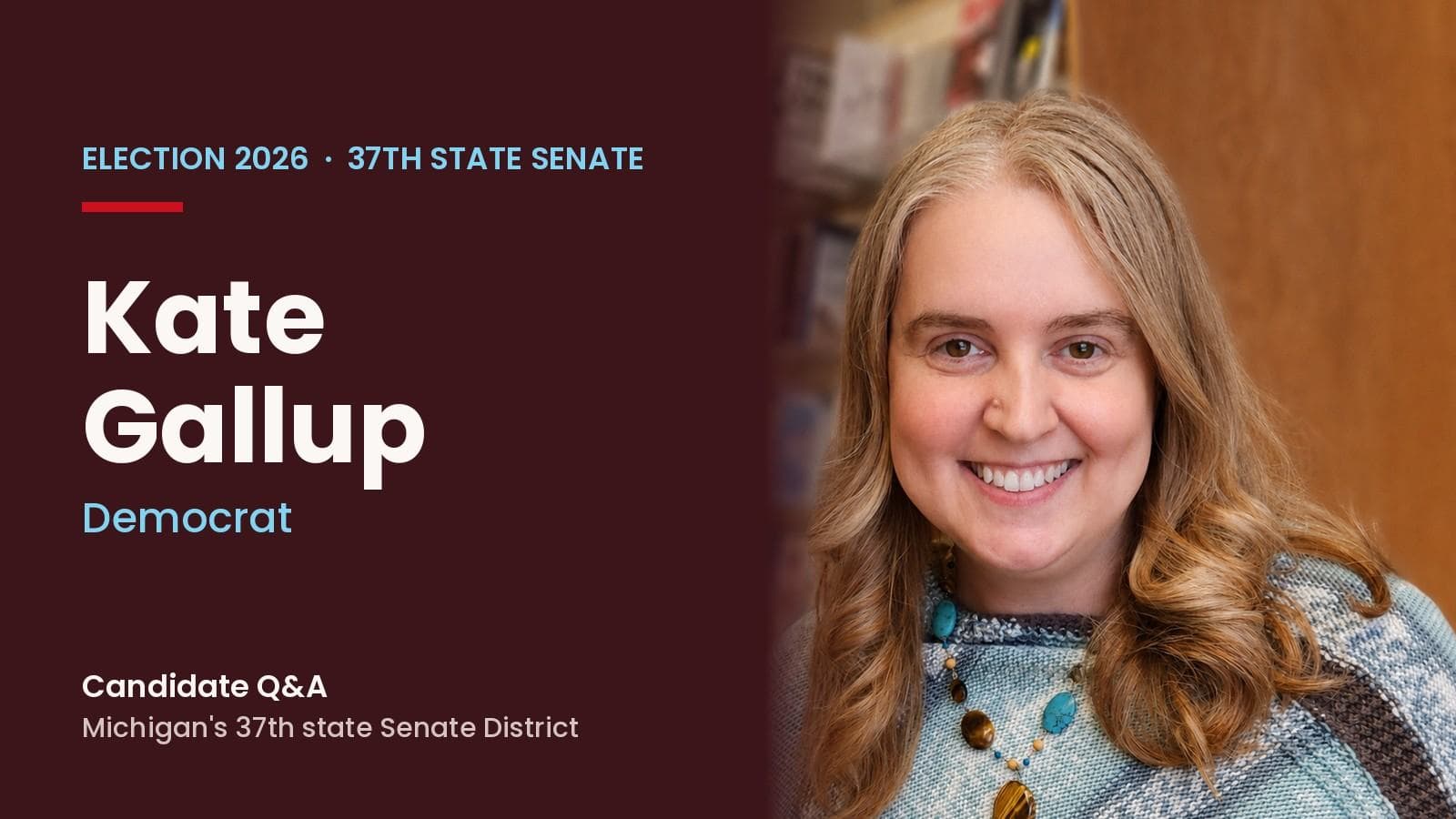
Source: Courtesy of the Kate Gallup campaign
Democrat Kate Gallup seeks to unseat Damoose in 37th state Senate District
Oct 13, 2026, 4:15 PM ET
Share


This story was reported by 9&10 News for the Northern Michigan Journalism Collaborative.
State Sen. John Damoose, R-Harbor Springs, wants to return to Lansing to represent the 37th state Senate District covering Antrim, Charlevoix, Cheboygan, Emmet, Grand Traverse and Leelanau counties and parts of Mackinac and Chippewa counties.
But he’ll have to go through Democrat Kate Gallup in the Nov. 3 election first.
Gallup spoke with 9&10 News about what she’d do if voters sent her to Lansing.
Please give some background on yourself and why you’re running for the state Senate.
My key priorities are getting money out of politics, fully funding our schools so our kids have quality education, protecting our land and water, and passing the MiCare plan, healthcare for all.
I decided to run for office after working on citizen-led ballot initiatives, including Money Out of Politics, Invest in MI Kids, and ranked-choice voting. I’ve loved seeing the energy behind these causes, driven by people who feel neither side is getting things accomplished, so they take action themselves.
As a state legislator, I could do more for the people and communities I care about and advance my platform.
It’s important to have someone in office who represents people’s values, looks out for them, and ensures the needs of the people speak louder than corporate interests.
What do you see as the most significant challenges facing Michigan’s economy, and what policies would you support to address some of these worries?
Michigan households shoulder the highest estimated tariff costs per capita in the nation right now, averaging $5,600 to $6,400 per household since January 2025. And that means that our importers and consumers have had to absorb over $25 billion in tariff burden in the automotive, agricultural, and manufacturing sectors.
The tariff isn’t something that I can do anything about as a state legislator. But we have an opportunity to stand up to the rubber-stamping that has gone on at all levels of government, from the local level all the way to federal level, that has allowed this to happen to the Michiganders who bear this burden.
I don’t think that Sen. Damoose has done enough to call out the GOP sycophants that are allowing this to happen to our state, and I don’t think he’s doing enough to address the consequences of this happening to our state by the GOP.
It is our own president, and it is our own people in office, who have allowed these policies to happen, and he is, I believe, part of that issue.
Are there any policies you’d consider to help lower the cost of living in Michigan?
One thing that people also deal with is the rising cost of utility rates, and that’s actually what the Michiganders for Money Out of Politics ballot initiative was for. It says that our publicly regulated utilities cannot donate in campaigns that have a conflict of interest. And that allows for state legislators and those in the executive branch, who appoint our commission that oversees the utilities, to actually have the backbone to stand up to rising rates for lower services.
We can stop supporting increases that put profits over people for less service.
And, unlike my opponent who takes thousands in utility money, I take zero, and I think it’s really important that people have someone they can vote for who isn’t playing into these special corporate interests that materially place strong burdens on Michiganders.
I’m also supportive of fair rent policies and rent protection for our renters.
For the food costs that people are facing, how can we work with our local agricultural businesses to help them there? Getting more agriculture into people’s homes from their local environment and into schools.
What policies would you support regarding housing access?
I would like to see continued incentives for low-income and first-time homebuyers, and I would really like to see additional protections for renters and tenants.
I was in Sault Ste. Marie yesterday, and I met a guy named Randy, who had been a landlord, and he sold his building. And he found out that some of his tenants that had been part of that building were now homeless, and that’s because there weren’t a lot of protections on the rental increases for them, and it had gone well beyond. He mentioned bills they had in California, like the California Tenant Protection Act, and other things that he felt might have been actually helpful to these tenants. I think that we absolutely need to have more rights for some of our renters.
I am glad to see that there is now a law that renters have to have fee-free ways to pay — but more can be done, especially as we have increasing numbers of people who can’t afford to actually own their home. The people who are renting and are a source of income for others need to be treated with dignity.
Do you feel that the state should be doing more to ensure the availability of and access to healthcare services?
We need something like MiCare, healthcare for all here in Michigan.
I know so many people that have lost healthcare — they can’t afford the premiums, so they just have given up on health insurance at all. They make too much to qualify for Medicaid because they’re working full-time, but they also are not making enough to pay thousands per month in healthcare premiums.
It’s something that will take multiple reforms and effort, but it’s absolutely possible that every Michigander is taken care of, and that we don’t have people facing these burdens and the stress of being simply one health crisis away from total bankruptcy or on the street. One thing I want to look at is more investment here, bringing more grants from the state level into this area.
We also need more mental health services here, because, currently, people can’t be served for severe mental health issues while here in northern Michigan. That is absolutely something that we should continue to invest in, as well as our community health clinics and making sure that our healthcare workforce can actually afford to live in these communities.
Are there any changes you’d like to see to Michigan’s education system?
The actual inflation-adjusted dollars of money going to our schools are at a 30-year low, and we need to fully fund our schools. Part of that is providing the right supports in the classroom. It’s also getting back to and just making sure that schools are using the Science of Reading, but even beyond that, making sure that we have our reading specialists and supports for our kids who are struggling in schools.
Making sure there’s supports for our students that need additional services and pullout services, mental health services in schools. Focusing on how to get back to smaller class sizes, how to get back to the right supports, and making sure that the ways in which we’re teaching kids are the most evidence-based methods.
All of these things cost money — but I think the bigger picture is that we want to live in an educated society. We want our youth to be creative individuals that also are able to think logically and make good decisions. And so our students are an investment.
How do you see artificial intelligence impacting people in Michigan currently, and where do you see the technology going in the future?
With AI, it has the promise to help in certain ways, but the issues with it and the rollout of it have been so bad.
There’s this side of AI that can be used to solve various problems in science and medicine. But I think there’s a real issue with the fact that we don’t have strong enough guardrails and controls. We haven’t set up standards to protect children using AI. We haven’t even set up standards to protect anyone in how it’s used, or how corporations are able to use it, how they’re able to sell it to us, how they’re able to use public money to invest in using AI.
Also, we see the issue of AI in mass surveillance. I was at the Antrim County commission meeting where they were talking about Flock cameras and taking on these cameras with Flock.
Well, Flock cameras use AI to track people, not just by their license plates, but also by their car make and model — and it’s imperfect. And people are rightfully worried about what this future surveillance state will mean for their life and what it will mean if they’re wrongly accused or if this technology is used to stalk them.
Do you support the development of data centers in Michigan and/or tax incentives for their development?
I don’t think that our tax incentives are the right approach here in Michigan.
I know that they were put in place because they’re trying to bring in this business and the construction jobs to build the data centers. But we already have great resources here in Michigan that are attractive to data centers, and I think that for a data center development, it has to make sense for the communities hosting them, and making sure that the environmental impact and long-term impact is counterweighted by a big public benefit.
Communities need to have the tools to work with developers, to have them be a net benefit if they’re going to have them in their community at all. But our residential, small businesses and just citizens in general shouldn’t be subsidizing these trillion-dollar corporations.
The other issue is just that, to me, right now, there’s kind of this AI data center bubble. There’s not been enough done to make sure that these companies don’t just put in these projects and then leave in three to five years, leaving their local communities on the hook for abandoned sites and environmental damage.
This reporting is made possible by the Northern Michigan Journalism Collaborative, led by Bridge Michigan and Interlochen Public Radio, and funded by Press Forward Northern Michigan.

