

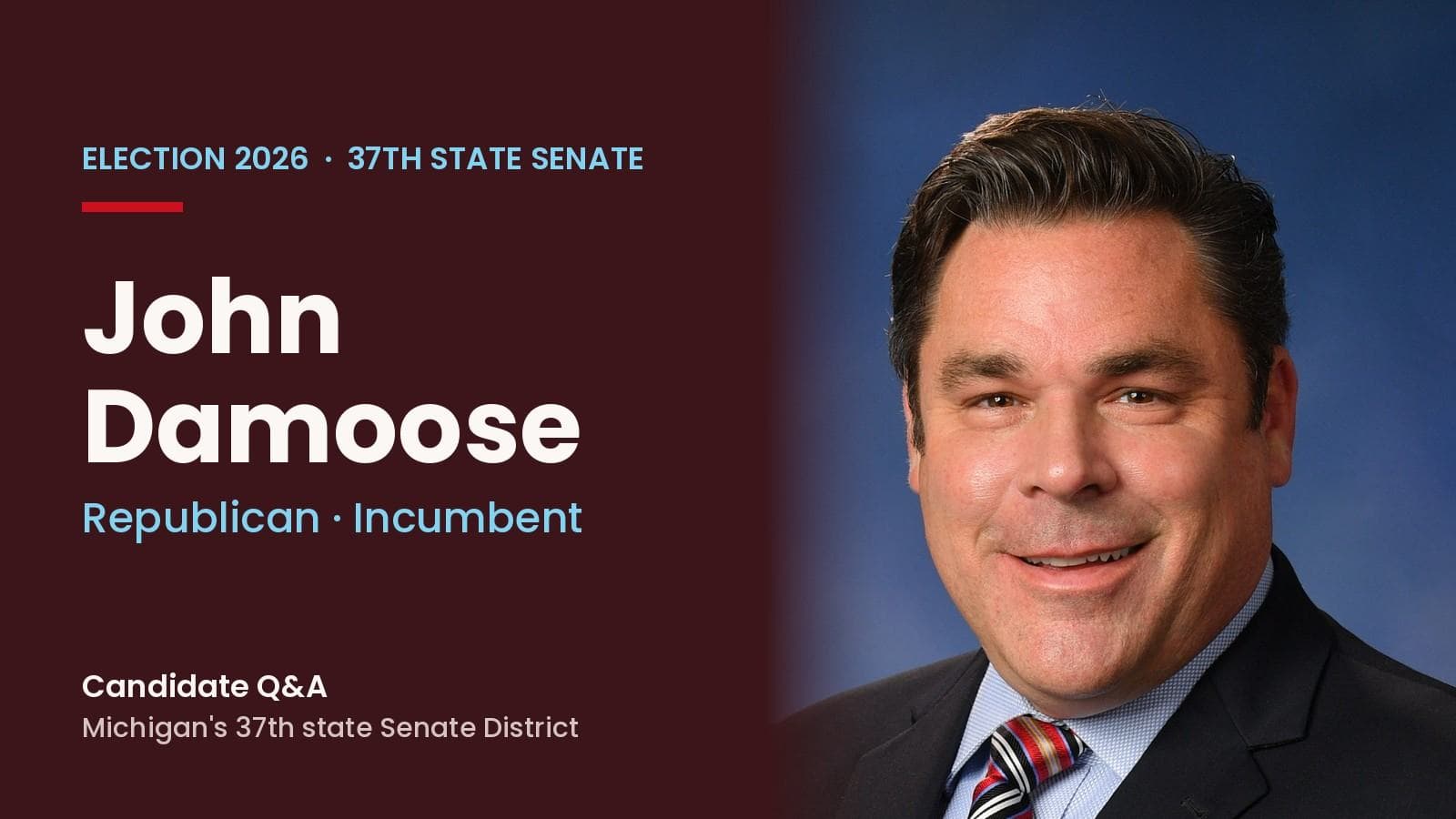
Source: Michigan Senate Republicans
John Damoose seeks reelection to state Senate
Oct 13, 2026, 4:14 PM ET
Share


This story was reported by 9&10 News for the Northern Michigan Journalism Collaborative.
John Damoose, R-Harbor Springs was first elected in 2022 to the 37th state Senate District, which covers Antrim, Charlevoix, Cheboygan, Emmet, Grand Traverse and Leelanau counties and parts of Mackinac and Chippewa counties.
He wants to return to Lansing next year but first must beat Democrat Kate Gallup in the Nov. 3 election.
Damoose spoke with 9&10 News about why he’s running and what he’d do if voters send him back to the Capitol.
Please give some background on yourself and why you’re running for reelection.
My life and public service are shaped by northern Michigan’s values: faith, family, hard work, personal responsibility and deep respect for community and tradition.
I’ve been a Harbor Springs resident since childhood. Me and my wife, Margo, raised four children, built a successful business, and served our neighbors. I graduated from the University of Michigan, building a career as a businessman, storyteller, and television producer, creating national documentaries celebrating American history, leadership, military service and manufacturing.
Today, I represent Michigan’s 37th Senate District, working to bring common sense, civility and a results-oriented approach to the Legislature.
I support Michigan manufacturing, workforce development, skilled trades, small businesses and northern Michigan families. My bipartisan efforts include combating human trafficking, supporting tourism and strengthening the region’s year-round economy.
I believe public office is about stewardship, not personal ambition — defending northern Michigan’s way of life and building a stronger future for the next generation.
Broadly, what do you see as the most important state-level issues for voters in 2026?
Without question, it’s the economy and affordability across a broad range of issues — from housing to gas prices to the price of groceries to prescription drugs, you name it. Even yesterday, I pumped up and it was $4.61 a gallon. And for a brief moment, I was excited to see that, because I just paid almost $5 the other day.
That’s not a good price. It’s terrible.
And housing is a huge one, especially up here. My daughter — I have a daughter who lives in Pittsburgh — and I’m really excited, someday, she’d love to move home. But I drove by not long ago a little starter home across from a school and sort of a busy area there, and I thought this would be so perfect, it’s so adorable for her. And I ran home and looked it up — it was $460,000. I mean, what kid can afford that?
So I think that is top of everybody’s minds, as it should be.
What do you see as the most significant challenges facing Michigan’s economy, and what policies would you support to address some of these worries?
Almost every statistic I see across the nation, Michigan’s at the bottom. Whether you’re talking about economic growth, population growth, you name it — the fact is that we’ve had terrible policies for a lot of years across both Republican and Democratic administrations that have really driven companies out of the state.
It’s going to cost us money to bring people back here. I worked with a Democratic colleague to develop a package of bills leading to a 10-year economic development plan, because we have no rhyme or reason behind our plans here and we offer no consistency whatsoever to companies.
We need to change that.
We have a unique set of circumstances in northern Michigan. The biggest concern I have economic-wise is building a more vibrant year-round economy.
Don’t get me wrong, I love our tourism industry. But living only on that is sort of like eating candy three meals a day. It’s just not a healthy environment. And if we want to build an economy where our kids can grow up and stay closer to home and build their careers here at home, we need to foster more small businesses and more manufacturing. And this is something I’ve worked very hard on.
Are there any policies you’d consider to help lower the cost of living in Michigan?
When it comes back to affordability, a lot of this can’t be fixed at the state level. Some of these prices are being caused by factors at the national and international level that we frankly have no control over, like these across-the-board tariffs that I believe are really hurting our families.
As a state senator, I can’t actually do much to change the tariffs other than to sort of sound the alarm, which I’ve been doing, especially related to Canada.
That said, there are policies we can pursue that will help. Some of them are small, but these small things add up.
I recently supported a package of bills that crack down on surprise subscription renewals, which cost the average family hundreds of dollars a year. I was the only Republican to vote across the aisle on the Prescription Drug Affordability Board last year to help bring down the prices of prescriptions for all Michigan residents.
We can do a lot of these little things, and if you string together enough of them, you can make some progress.
But the bulk of the problem needs to be fixed at the federal level.
What policies would you support regarding housing access?
The good thing is that everybody is on this now. I mean, everybody is unified, especially in places like where we live in northern Michigan here — we understand the crisis. It’s going to take a lot of different solutions from different places.
One of the things that I’ve been happy to support and to be a part of is we were able to help secure $5 million for a (Traverse City Area Public Schools) teacher housing program that was really interesting. Another idea came to me from the superintendent of schools on Beaver Island, and they have a horrible time finding teachers because it’s difficult and expensive to find a place to live on the island. He asked me to sponsor a bill that hasn’t passed yet that would allow schools to use some of their funding to build teacher housing.
We’ve got to maintain local control over short-term rentals, because even in the town I live in, 60% to 70% of the homes aren’t even being used for homes — they’re second homes or they’re short-term rentals, and that’s just devastating the housing market for our residents.
While I love having visitors come up here, my top priority is helping our people ensure they can access affordable homes.
Do you feel that the state should be doing more to ensure the availability of and access to healthcare services?
Just like some of the affordability issues, a lot of this is more of a federal issue. But that doesn’t mean we’re powerless.
One policy that I’ve supported allows licenses to transfer from other states. There was a big barrier to hiring physicians from other states because Michigan’s licensing program didn’t recognize what they already had in their state. So there’s an interstate licensure compact that we really pushed through, and that’s going to help.
Some of it comes down to funding. I was able to secure $13 million of funding for mental health services in northern Michigan, because the fact is we hardly have any. We’ve been working on a big center for youth in the Traverse City area, which we haven’t gotten through yet. But we’re working on it.
I’m not a healthcare expert by a long shot. But the key is that you have to build relationships, and I work with physicians and hospitals and anybody related to healthcare to learn more every single day. They’re the ones coming up with the good ideas, and it’s our job to implement them.
Are there any changes you’d like to see to Michigan’s education system?
This is such a crazy position we’re in right now, because on the one hand you see how we rank against other states and we’re 43rd in reading, 37th in overall education performance. At the same time, we have teachers who are working their brains out, working really hard. We have great administrators throughout northern Michigan. We’re spending more money than we ever have on education, so something’s not connecting like it should.
The bottom line is, when you’re 43rd or 44th in the nation, that’s not the time to get rid of laws that could be a tool to help push performance. The other thing that I’m concerned about is that there’s been a big push to get rid of the standards. We got rid of the third-grade reading law a couple years ago, and A to F school rankings. Parents should know how their schools are performing compared to other schools in their area.
We need to take a deep dive into some of these policies, like the Science of Reading, and also rekindle our interest in developing these standards for schools. Because, if we’re going to spend this much money, we better get some results for it.
How do you see artificial intelligence impacting people in Michigan currently, and where do you see the technology going in the future?
This is all happening so fast, and so I’m in the same boat as a lot of residents here. We see on the one hand that AI has real potential. They’re using AI to try to determine what drugs could be useful on what conditions in a way that the human mind could never do.
But there definitely need to be guardrails on this thing. You’ve seen that the people who are pushing AI, the very companies behind that, are now coming out in droves saying, “We need to slow this down, this has a tremendous potential for destruction throughout human society here.”
One area I’m really concerned about is so-called sextortion. A lot of this is being driven by AI, and this is where a kid sitting at home on social media, he thinks he’s talking to a girl or flirting with somebody, and they convince him to send a picture he shouldn’t send. This type of thing is happening all over the place. And a lot of times, they’re not even talking to a real person on the other end. They’re talking to an AI-generated chatbot. This is dangerous, scary stuff.
Do you support the development of data centers in Michigan and/or tax incentives for their development?
I’m very much in favor of pressing pause. Long-term, we all rely on computers. We rely on our phones, and there needs to be data centers somewhere. Long-term, we need to recognize that.
We also need to recognize that, evidently, there are good economic cases in certain limited areas where a data center might make sense. But our people in the local areas need to be the ones making these decisions.
Right now, I don’t think the state of Michigan should be spending a dime on incentives for these until this is resolved in the public sphere, and that’s going to take some time.
If these things have value, the people behind them didn’t take any time to bring people along with them to get local buy-in, to explain what this can do, to explain what it doesn’t do.
Instead, they charged into it, and, as a result, nobody wants to build a data center in the state of Michigan right now. I just think there needs to be a moratorium on it.
Doesn’t mean not ever. It just means not now, until we develop broad consensus.
This reporting is made possible by the Northern Michigan Journalism Collaborative, led by Bridge Michigan and Interlochen Public Radio, and funded by Press Forward Northern Michigan.

