

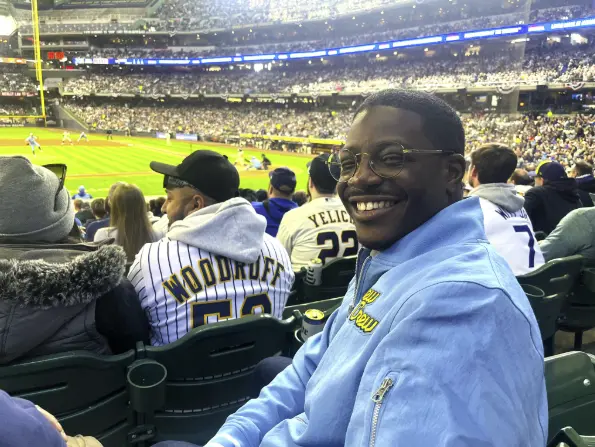
Milwaukee County Executive David Crowley was "key" in keeping the Milwaukee Brewers in town.
Source: Provided by Crowley campaign
How County Executive David Crowley saved American Family Field and the Milwaukee Brewers

The Milwaukee Brewers are playing in the World Series for the first time in 44 years, but baseball almost left Wisconsin again, if not for the leadership of Milwaukee County Executive David Crowley.
That’s according to Gov. Tony Evers and labor union leaders who were involved in the negotiations to extend to keep the Brewers at American Family Field until 2050.
Crowley, now the Democratic nominee for Wisconsin governor, insisted that the county and city tax burden be reduced and there was a moment that no one involved in negotiations got along, according to Evers, but Crowley brought everyone together — for Milwaukee, for Wisconsin, for baseball.
"Everybody was giving their two cents, but he worked together with a bunch of people that were doing everything they could to not work together," Evers told the Milwaukee Journal Sentinel last week. "As a result of that, it was a good result. We saved the Brewers. We also got more money, significant money, into all the municipalities, not just Milwaukee County, but the entire state."
Crowley was “instrumental” in negotiating the American Family Field deal that will keep the Milwaukee Brewers in Milwaukee until 2050, said John Jacobs, vice president of the IBEW state conference.
American Family Field is a huge job of work for the IBEW members, drawing workers from across the state year-round to work on maintenance and improvements at the field, Jacobs told Urban Milwaukee. “We were involved from the very beginning in the hopes of keeping the team around and, in this case, pleasantly surprised until 2050, which is outstanding.”
In 2023, the deal making process consisted of Milwaukee elected officials, including the mayor, county executive, union officials, and community leaders, as well as Republican and Democratic legislative leaders and the governor.
A few months into the process, Crowley said, “I look forward to discussions with partners in the Wisconsin State Legislature and I am willing to work with them to find a common ground, bipartisan solution. However, it is important to recognize Milwaukee County is still facing a significant fiscal deficit over the next several years. Any new proposal by the State of Wisconsin must recognize that reality.”
Crowley’s motivation was centered on the deal being “good for the taxpayers, good for the state of Wisconsin, in our jurisdiction here within Milwaukee County, but also good for the Brewers.” It was not until the deal’s county and city tax burdens were reduced that Crowley agreed to the deal.
The $500 million dollar deal that was ultimately struck to renovate and repair the stadium included money from the Brewers, Milwaukee County and city and the state. David’s work also led to roughly $240 million in flexible revenue for Milwaukee county, and the revenue generated by the stadium is projected to cover taxpayers' investment.
At the time, Major League Baseball and Brewers ownership considered moving from Milwaukee in 2030 if the deal broke down.
Professional baseball has been played in Milwaukee for nearly 150 years. More recently, from 1953 to 1965, the Milwaukee Braves were in Wisconsin, winning a World Series with Hank Aaron in 1957. But the Braves moved to Atlanta and in 1970, the Seattle Pilots moved to Milwaukee and the name was changed to the Brewers.
Milwaukee returned to the World Series in 1982 but lost. Now, after 44 years, the Brewers are going back and the local economy thanks them.
Each postseason Brewers game at American Family Field will generate an estimated $3.55 million in direct spending at hotels, restaurants and other area businesses, according to Visit Milwaukee. When applying the standard multiplier effect that accounts for those dollars reentering the community, the investment increases to $5.1 million per game.
The direct spending estimate per game includes lodging, $641,634; transportation,
$551,301; food and beverage, $655,410; retail, $870,201; recreation, $682,244,
business services, $145,402, and space rental, $5,570.
Milwaukee business leaders and owners laud economic impact of Brewers staying in Milwaukee and reaching the World Series this year.
“‘When we have teams here, we get more income tax revenue from that.’...Wisconsin had a ‘real risk of losing the Bucks and Brewers’ franchises...‘You can see from the numbers, the economic impact’s good and over time, the investment the state has made in American Family Field to keep the Brewers here is showing a good return on investment,” said Metropolitan Milwaukee Association of Commerce President and former GOP state senator Dale Kyoonga.
“People are coming into town. We are already getting calls. People out from California,” said Third Street Market owner Omar Shaikh. “It’s going to be a great influx of people, and we are gearing up. I think we are going to be busy.”
“‘At the end of the day, if they aren’t leveraging this, they are making a marketing mistake, but so far it seems they are doing a great job of it,’” said Marquette University advertising instructor David Hanneken.
Hanneken said a deep playoff run can help increase future revenue, including ticket sales, sponsorships, and in-stadium advertising.
“As they start to get more exposure, they can start to charge more for those sponsorships. They leverage that into the next season,’” he said.
Hanneken pointed to the Kansas City Royals’ 2015 World Series win as an example of a smaller-market team seeing financial benefits from a postseason run.
“Their revenue went up over $200 million for being in that postseason,” Hanneken said. “What is interesting is the value of the team went up $300 million.”
Other businesses — Brat House, Visit Milwaukee, National Bakery, Drop Chocolate, Brew Town Trading Company, Kelly’s Bleachers and Scheels in Eau Claire — each lauded the success of keeping the Brewers in Milwaukee for years to come.

Drake Bentley is the general assignment reporter for the Milwaukee Courier, covering politics, sports and the community. He is an award-winning investigative journalist who has worked for the Milwaukee Journal Sentinel, Wisconsin State Journal, Newsweek, Heavy and The Sporting News. He is a northside Milwaukee native, former political staffer and graduate of the University of Wisconsin-Whitewater and the University of Nebraska.
